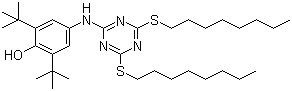
2,4-Bis(octylthio)-6-(4-hydroxy-3,5-di-tert-butylanilino)-1,3,5-triazine is a synthetic compound that has garnered attention for its unique properties and potential applications in various fields. This compound, with a complex molecular structure, is categorized as a triazine derivative, which is known for its role in agriculture and materials science. The synthesis of this compound is typically achieved through multistep reactions involving triazine derivatives and various thiol compounds, leading to the final product with octylthio groups and a functional aniline moiety.
The discovery of 2,4-bis(octylthio)-6-(4-hydroxy-3,5-di-tert-butylanilino)-1,3,5-triazine dates back to research aimed at developing effective agrochemicals and antioxidants. Its distinctive structure provides valuable properties, including enhanced solubility and stability, making it suitable for specific applications. Researchers have noted that the incorporation of octylthio groups contributes to the hydrophobic character of the compound, while the hydroxy and tert-butyl groups increase its chemical reactivity and potential for interaction with other substances.
One of the primary applications of this compound is as an antioxidant in polymer formulations. In the production of plastics and rubbers, antioxidants are critical for preventing oxidative degradation, which can compromise the material's mechanical properties and lifespan. The incorporation of 2,4-bis(octylthio)-6-(4-hydroxy-3,5-di-tert-butylanilino)-1,3,5-triazine into polymer matrices has demonstrated improved stability and resistance to oxidative stress, enhancing the durability of various products.
In addition to its role in materials science, this compound has also been studied for its potential use in agricultural applications. The triazine moiety is known for its herbicidal properties, and the introduction of the octylthio and aniline groups may enhance the bioactivity of the compound against specific weed species. Research indicates that derivatives of triazine compounds can act as effective herbicides, and ongoing studies aim to evaluate the efficacy of 2,4-bis(octylthio)-6-(4-hydroxy-3,5-di-tert-butylanilino)-1,3,5-triazine in this context.
Furthermore, the compound's structural features lend themselves to exploration in the field of organic electronics. The presence of the aniline moiety can facilitate charge transport, which is essential for the performance of organic semiconductors. As researchers continue to investigate the electronic properties of this compound, its potential applications in organic photovoltaic cells and light-emitting diodes (LEDs) are of significant interest.
Environmental safety and toxicity assessments are essential for understanding the implications of using 2,4-bis(octylthio)-6-(4-hydroxy-3,5-di-tert-butylanilino)-1,3,5-triazine in various applications. Initial studies suggest that while the compound exhibits desirable chemical properties, comprehensive evaluations are necessary to ensure its safe use in industrial and agricultural contexts.
In conclusion, 2,4-bis(octylthio)-6-(4-hydroxy-3,5-di-tert-butylanilino)-1,3,5-triazine is a multifaceted chemical compound with promising applications in materials science, agriculture, and organic electronics. Its unique structure and properties highlight its potential as an important agent in enhancing the stability and performance of various products, paving the way for further research and development in these fields.
|


 GHS07 Warning Details
 Discovory and Applicatios