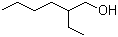
2-Ethylhexanol is a branched-chain fatty alcohol with the molecular formula C8H18O and the structural formula CH3(CH2)3CH(C2H5)CH2OH. It is a colorless liquid with a faint, characteristic odor and is only slightly soluble in water but miscible with most organic solvents. The compound belongs to the class of higher alcohols and is notable for its eight-carbon backbone with a branching at the second carbon.
2-Ethylhexanol was first synthesized through industrial processes involving the aldol condensation of n-butyraldehyde, followed by hydrogenation. This method, known as the oxo process or hydroformylation, is still widely used today and provides a reliable route for large-scale production. The compound has been extensively studied, and its physical, chemical, and toxicological properties are well established in the literature.
The primary use of 2-ethylhexanol is as a feedstock in the production of plasticizers, particularly di(2-ethylhexyl) phthalate (DEHP) and other phthalate esters. These plasticizers are essential additives in the manufacture of flexible polyvinyl chloride (PVC) and are used in a broad range of applications including cables, flooring, wall coverings, medical devices, and automotive parts. 2-Ethylhexanol reacts with phthalic anhydride or other acid derivatives to form esters with plasticizing properties, contributing to the flexibility, durability, and workability of polymer products.
Beyond plasticizer production, 2-ethylhexanol is used in the manufacture of acrylate and methacrylate esters, which serve as monomers in adhesives, coatings, and paints. Its compatibility with various resins and polymers makes it a valuable intermediate in the coatings industry.
2-Ethylhexanol is also employed in the synthesis of lubricants, surfactants, and solvents. It serves as a low-volatility alcohol in metalworking fluids, hydraulic fluids, and textile finishing agents. In addition, it functions as a solvent or carrier in agricultural formulations such as herbicides and pesticides, due to its ability to dissolve hydrophobic active ingredients.
Its use in consumer products is generally indirect, as it is incorporated into finished materials and formulations. Nevertheless, occupational exposure during production and processing is controlled to minimize risks, as inhalation or skin contact with vapors or liquids can cause irritation.
The compound has a boiling point of approximately 184 °C and a melting point around –76 °C. It is combustible and must be stored under appropriate conditions to prevent fire hazards. Despite its relatively low acute toxicity, proper handling and safety measures are required to manage its use in industrial environments.
In conclusion, 2-ethylhexanol is a key industrial alcohol with extensive applications in the manufacture of plasticizers, coatings, adhesives, and specialty chemicals. Its established production methods and versatile reactivity ensure its ongoing importance in chemical processing and materials science.
References
2002. Active Site Mutations of Cytochrome P450cam Alter the Binding, Coupling, and Oxidation of the Foreign Substrates (R)- and (S)-2-Ethylhexanol. Archives of Biochemistry and Biophysics, 398(2).
DOI: 10.1006/abbi.2001.2732
2006. Metabolites from the biodegradation of di-ester plasticizers by Rhodococcus rhodochrous. The Science of the Total Environment, 360(1-3).
DOI: 10.1016/j.scitotenv.2005.06.020
2010. Fragrance material review on 2-ethyl-1-hexanol. Food and Chemical Toxicology, 48(Suppl 4).
DOI: 10.1016/j.fct.2010.05.042
|




 GHS07 Warning Details
 chemBlink Chemical Story