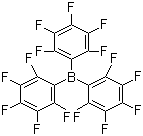
Tris(pentafluorophenyl)borane, often written as B(C6F5)3, is a potent, moisture-sensitive Lewis acid that rose to prominence in the 1990s and has since become a versatile reagent in organic and main-group chemistry. The compound consists of a boron center bound to three pentafluorophenyl groups; the strong electron-withdrawing nature of the perfluorinated aryl rings stabilizes the empty p orbital on boron and markedly enhances Lewis acidity relative to triarylboranes bearing nonfluorinated aryl groups. The combination of high Lewis acidity, thermal robustness, and relative resistance of the B–C bonds to cleavage under many reaction conditions underlies the broad utility of B(C6F5)3.
The preparation of tris(pentafluorophenyl)borane is typically accomplished by routes that introduce pentafluorophenyl groups onto boron, for example by transmetallation from pentafluorophenylmetal reagents to boron halides or by reaction of pentafluorophenylmagnesium bromide with boron electrophiles under controlled conditions. Early synthetic and structural studies established the threefold aryl substitution and the propeller-like arrangement of the aryl rings around boron; these structural features influence the steric accessibility of the boron center and therefore its reactivity with Lewis bases.
Applications of B(C6F5)3 span Lewis acid catalysis, stoichiometric activation of substrates, and its central role in the development of frustrated Lewis pair (FLP) chemistry. As a Lewis acid, it catalyzes transformations such as hydrosilylation, hydroboration, polymerization initiation, and activation of carbonyl and imine substrates, often enabling reactions under milder conditions than classical Lewis acids. In FLP chemistry, the combination of a sterically encumbered Lewis base with B(C6F5)3 produces systems that are unable to form a classical Lewis adduct but can cooperatively activate small molecules; this approach led to metal-free heterolytic cleavage of H2 and subsequent catalytic hydrogenation methodologies that avoid transition metals.
Beyond catalytic reactions, B(C6F5)3 is used to generate noncoordinating counterions by forming borate salts such as [B(C6F5)4]⁻, which stabilize reactive cationic intermediates in coordination and organometallic chemistry. The reagent finds application in hydride abstraction, carbocation generation, and stabilization of highly electrophilic species useful in polymerization and borylation processes. Advances in borylation chemistry have exploited B(C6F5)3 both as reagent and as catalyst precursor for site-selective functionalization and for the preparation of complex organoboron compounds.
Handling and storage of tris(pentafluorophenyl)borane require exclusion of moisture and protic contaminants because the borane undergoes rapid adduct formation and hydrolysis in the presence of water. The water adduct of B(C6F5)3 can exhibit Brønsted acidity, and traces of moisture can diminish Lewis acid activity; accordingly, practitioners store and manipulate the reagent under inert atmosphere and use rigorously dried solvents and glassware in sensitive applications.
Because B(C6F5)3 is a cornerstone reagent in modern main-group and organometallic chemistry, methodological and mechanistic studies have focused on quantifying its Lewis acidity, mapping its reactivity profile with various donors, and understanding its fate under catalytic conditions. Such studies informed practical guidelines for catalyst design, selection of compatible reaction partners, and mitigation of deactivation pathways. The combination of strong, tunable Lewis acidity and broad reaction compatibility has made tris(pentafluorophenyl)borane an enabling reagent in both academic and industrial synthetic chemistry.
References
Piers WE, Chivers T (1997) Pentafluorophenylboranes: from obscurity to applications. Chemical Society Reviews 26 345–354 DOI: 10.1039/CS9972600345
Welch GC, Stephan DW (2007) Facile heterolytic cleavage of dihydrogen by phosphines and boranes. Journal of the American Chemical Society 129 1880–1881 DOI: 10.1021/ja067961j
Lawson JR, Melen RL (2017) Tris(pentafluorophenyl)borane and beyond: modern advances in borylation chemistry. Inorganic Chemistry 56 8627–8643 DOI: 10.1021/acs.inorgchem.6b02911
|





 GHS06;GHS07 Danger Details
 Discovery and Applications