
Online Database of Chemicals from Around the World
| Trademax Pharmaceuticals & Chemicals Co., Ltd. | China | |||
|---|---|---|---|---|
 | www.trademaxchem.com | |||
 | +86 (21) 5238-7770 | |||
 | +86 (21) 5238-7129 | |||
 | trademax@trademaxchem.com | |||
| Chemical distributor since 2001 | ||||
| chemBlink Standard supplier since 2006 | ||||
| Capot Chemical Co., Ltd. | China | |||
|---|---|---|---|---|
| www.capotchem.com | |||
| +86 (571) 8558-6718 +86 13336195806 | |||
| +86 (571) 8586-4795 | |||
| capotchem@gmail.com sales@capotchem.com | |||
 | QQ Chat | |||
| Chemical manufacturer | ||||
| chemBlink Standard supplier since 2006 | ||||
| Jilin Optical and Electronic Materials Co., Ltd. | China | |||
|---|---|---|---|---|
| www.jl-oled.com | |||
| +86 (431) 8583-4771 | |||
| +86 (431) 8583-4772 | |||
| sales1@jl-oled.com | |||
| Chemical manufacturer since 2005 | ||||
| chemBlink Standard supplier since 2010 | ||||
| BOC Sciences | USA | |||
|---|---|---|---|---|
| www.bocsci.com | |||
| +1 (631) 485-4226 | |||
| +1 (631) 614-7828 | |||
| info@bocsci.com | |||
| Chemical manufacturer | ||||
| chemBlink Standard supplier since 2010 | ||||
| Earlier HK Company Limited | China | |||
|---|---|---|---|---|
| www.earlierchem.com | |||
| +86 (10) 6142-6769 +86 18616907430 | |||
| +86 (10) 6142-6769 | |||
| info@earlierchem.com | |||
| QQ Chat | |||
| Chemical manufacturer since 2011 | ||||
| chemBlink Standard supplier since 2013 | ||||
| Baike Biotech (shanghai) Co., Ltd. | China | |||
|---|---|---|---|---|
| www.biooke.com | |||
| +86 (21) 6512-7018 | |||
| service@biooke.com | |||
| Chemical manufacturer since 2018 | ||||
| chemBlink Standard supplier since 2019 | ||||
| Neostar United (Changzhou) Industrial Co., Ltd. | China | |||
|---|---|---|---|---|
| www.neostarunited.com | |||
| +86 (519) 8555-7386 +86 18015025600 | |||
| +86 (519) 8555-7389 | |||
| marketing1@neostarunited.com | |||
| Chemical distributor since 2014 | ||||
| chemBlink Standard supplier since 2020 | ||||
| Luminescence Technology Corp. | Taiwan | |||
|---|---|---|---|---|
| www.lumtec.com.tw | |||
| +886 (2) 2697-5600 | |||
| +886 (2) 2697-5601 | |||
| sales@lumtec.com.tw | |||
| Chemical manufacturer since 1999 | ||||
| chemBlink Standard supplier since 2024 | ||||
| Xi'an Yuri Solar Co., Ltd. | China | |||
|---|---|---|---|---|
| www.yurisolar.com | |||
| +86 (029) 8110-1199 | |||
| jiaop@yurisolar.com | |||
| QQ Chat | |||
 | WeChat: plt18092602675 | |||
| Chemical manufacturer since 2007 | ||||
| chemBlink Standard supplier since 2025 | ||||
| Classification | Pharmaceutical intermediate >> OLED material intermediate |
|---|---|
| Name | 1,3,5-Tris(1-phenyl-1H-benzimidazol-2-yl)benzene |
| Synonyms | 1,3,5-Tris(N-phenylbenzimidazol-2-yl)benzene; 2,2',2''-(1,3,5-Benzenetriyl)tris[1-phenyl-1H-benzimidazole]; TPBi |
| Molecular Structure | 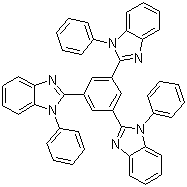 |
| Molecular Formula | C45H30N6 |
| Molecular Weight | 654.76 |
| CAS Registry Number | 192198-85-9 |
| EC Number | 848-939-2 |
| SMILES | C1=CC=C(C=C1)N2C3=CC=CC=C3N=C2C4=CC(=CC(=C4)C5=NC6=CC=CC=C6N5C7=CC=CC=C7)C8=NC9=CC=CC=C9N8C1=CC=CC=C1 |
| Density | 1.3±0.1 g/cm3, Calc.* |
|---|---|
| Melting point | 272-277 °C (Expl.) |
| Index of Refraction | 1.727, Calc.* |
| * | Calculated using Advanced Chemistry Development (ACD/Labs) Software. |
| Hazard Symbols |  GHS07 Warning Details GHS07 Warning Details |
|---|---|
| Risk Statements | H302-H315-H320-H335 Details |
| Safety Statements | P261-P280-P301+P312-P302+P352-P305+P351+P338 Details |
| SDS | Available |
 chemBlink Chemical Story
|
1,3,5-Tris(1-phenyl-1H-benzimidazol-2-yl)benzene is an organic compound that belongs to the class of trisubstituted benzenes, where each substitution is a 1-phenyl-1H-benzimidazol-2-yl group. This chemical structure has attracted significant interest in the field of materials science due to its unique electronic properties and potential applications in optoelectronic devices, including organic light-emitting diodes (OLEDs) and organic solar cells. The compound is a notable example of a ligand with strong electronic interactions and has shown promising behavior in the development of high-performance organic semiconductors. The discovery of 1,3,5-Tris(1-phenyl-1H-benzimidazol-2-yl)benzene dates back to research aimed at synthesizing new organic materials with tunable electronic properties. The benzimidazole group, known for its electron-rich nature, is often used in the design of ligands for coordination with metal centers, enhancing the stability and electronic properties of the resulting complexes. The trisubstitution of the benzene ring with these benzimidazole derivatives was an effort to create a stable, electron-rich aromatic compound that could serve as an effective electron donor or acceptor in various electronic applications. The synthesis of 1,3,5-Tris(1-phenyl-1H-benzimidazol-2-yl)benzene involves the reaction of a benzene derivative with phenyl-substituted benzimidazole moieties, typically facilitated by a coupling reaction. The resulting compound has a central benzene ring substituted with three 1-phenyl-1H-benzimidazol-2-yl groups. The phenyl groups attached to the benzimidazole rings enhance the solubility of the compound in organic solvents, making it easier to process for device fabrication. One of the primary applications of 1,3,5-Tris(1-phenyl-1H-benzimidazol-2-yl)benzene is in the field of organic electronics. It has been extensively studied for its use in organic light-emitting diodes (OLEDs), where its electron-rich nature and stability are critical for achieving high performance. In OLEDs, the compound acts as a hole transport material, which is essential for efficient charge injection and transport within the device. The electron-rich benzimidazole groups contribute to the compound's ability to transport positive charge carriers, improving the overall efficiency and brightness of OLED devices. Another important application of 1,3,5-Tris(1-phenyl-1H-benzimidazol-2-yl)benzene is in organic solar cells. Organic photovoltaic devices rely on the interaction between electron-donating and electron-accepting materials to generate electricity from light. 1,3,5-Tris(1-phenyl-1H-benzimidazol-2-yl)benzene has been used as part of the active layer in these devices, where it functions as an electron donor or as part of a donor-acceptor system, improving the light absorption and charge separation efficiency. The compound's ability to form stable thin films and its compatibility with solution processing techniques make it a promising material for low-cost, large-scale solar cell production. In addition to its uses in OLEDs and organic solar cells, 1,3,5-Tris(1-phenyl-1H-benzimidazol-2-yl)benzene has also been explored for use in other optoelectronic applications such as organic field-effect transistors (OFETs) and organic light-emitting transistors (OLETs). Its ability to transport charge efficiently, combined with its tunable electronic properties, makes it a versatile candidate for a wide range of organic electronic devices. Despite its potential, challenges remain in the optimization of devices based on 1,3,5-Tris(1-phenyl-1H-benzimidazol-2-yl)benzene. Issues such as the stability of the compound under operating conditions, the need for efficient device fabrication methods, and the enhancement of its charge carrier mobility must be addressed. Ongoing research aims to improve these aspects by modifying the molecular structure or exploring new processing techniques. In conclusion, 1,3,5-Tris(1-phenyl-1H-benzimidazol-2-yl)benzene is a promising material for a variety of optoelectronic applications, particularly in organic light-emitting diodes and organic solar cells. Its ability to transport charge efficiently, its stability, and its ease of processing make it a valuable compound in the development of advanced organic electronic devices. References 2022. A systematic review on 1,8-naphthalimide derivatives as emissive materials in organic light-emitting diodes. Journal of Materials Science, 57(2). DOI: 10.1007/s10853-021-06602-w 2022. Novel ternary exciplex system based on TCTA dendrimer with a new linking type amongst various functional donors. Journal of Materials Science: Materials in Electronics, 33(14). DOI: 10.1007/s10854-022-08113-z 2001. Light-Emitting Carbazole Derivatives: Potential Electroluminescent Materials. Journal of the American Chemical Society, 123(35). DOI: 10.1021/ja010819s |
| Market Analysis Reports |