
Online Database of Chemicals from Around the World
| Zhengzhou Kingorgchem Chemical Technology Co., Ltd. | China | |||
|---|---|---|---|---|
 | www.kingorgchem.com | |||
 | +86 (371) 6551-1006 | |||
 | +86 (371) 6575-6965 | |||
 | sales@kingorgchem.com | |||
 | QQ Chat | |||
 | WeChat: 18625597674 | |||
| Chemical manufacturer since 2015 | ||||
| chemBlink Standard supplier since 2016 | ||||
| Classification | Organic raw materials >> Organometallic compound >> Organic palladium |
|---|---|
| Name | CPhos Pd G3 |
| Synonyms | Methanesulfonato(2-dicyclohexylphosphino-2',6'-bis(dimethylamino)-1,1'-biphenyl)(2'-amino-1,1'-biphenyl-2-yl)palladium(II) |
| Molecular Structure | 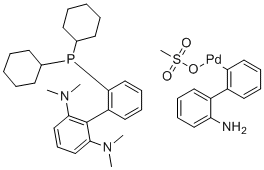 |
| Molecular Formula | C41H54N3O3PPdS |
| Molecular Weight | 806.34 |
| CAS Registry Number | 1447963-73-6 |
| EC Number | 963-657-0 |
| SMILES | CN(C)c1cccc(c1c2ccccc2P(C3CCCCC3)C4CCCCC4)N(C)C.CS(=O)(=O)O[Pd]c1ccccc1c2ccccc2N |
| Melting point | 176-178 °C (decomp.) |
|---|---|
| Hazard Symbols |  GHS07 Warning Details GHS07 Warning Details | ||||||||||||||||||||
|---|---|---|---|---|---|---|---|---|---|---|---|---|---|---|---|---|---|---|---|---|---|
| Risk Statements | H302-H315-H319-H335 Details | ||||||||||||||||||||
| Safety Statements | P261-P280-P301+P312-P302+P352-P305+P351+P338 Details | ||||||||||||||||||||
| Hazard Classification | |||||||||||||||||||||
| |||||||||||||||||||||
| SDS | Available | ||||||||||||||||||||
 Discovery and Applications
|
CPhos Pd G3, a sophisticated organopalladium complex, represents a significant advancement in catalytic chemistry. This compound is a palladium(II) complex with the ligand CPhos, which stands for 2-diphenylphosphino-2',4',6'-triisopropylbiphenyl. The designation "G3" refers to the third generation of this ligand's development, highlighting its evolution in enhancing catalytic performance. The discovery of CPhos Pd G3 is part of ongoing efforts to improve the efficiency and selectivity of palladium-catalyzed reactions. The CPhos ligand is known for its unique steric and electronic properties, which are crucial for stabilizing the palladium center and tuning its reactivity. The biphenyl backbone of CPhos is substituted with diphenylphosphine groups and triisopropylphenyl substituents, which together create a highly effective ligand environment. The CPhos ligand imparts significant steric bulk and electronic effects to the palladium center. The large, bulky isopropyl groups attached to the biphenyl ring reduce steric hindrance around the metal center, allowing for greater substrate access and improved reaction rates. The electron-donating properties of the phosphine groups further stabilize the palladium center, enhancing its ability to participate in various catalytic processes. CPhos Pd G3 is primarily used in cross-coupling reactions, such as the Suzuki-Miyaura and Negishi couplings. These reactions are pivotal in organic synthesis, enabling the formation of carbon-carbon bonds in a highly selective and efficient manner. The enhanced catalytic activity of CPhos Pd G3 makes it particularly valuable for the synthesis of complex organic molecules, including pharmaceuticals and advanced materials. In addition to cross-coupling reactions, CPhos Pd G3 has applications in other catalytic processes, including oxidative and reductive transformations. Its versatility is attributed to the finely tuned balance of steric and electronic effects provided by the CPhos ligand, which allows for effective catalysis across a range of reactions. The development of CPhos Pd G3 exemplifies the importance of ligand design in optimizing catalytic performance. By fine-tuning the ligand environment, researchers can achieve higher catalytic activity, selectivity, and stability, which are essential for advancing synthetic chemistry. In summary, CPhos Pd G3 is a highly effective palladium complex with significant applications in organic synthesis. Its advanced ligand system enhances catalytic efficiency and selectivity, making it a valuable tool in a wide range of chemical reactions. References none |
| Market Analysis Reports |