
Online Database of Chemicals from Around the World
| Zhengzhou Kingorgchem Chemical Technology Co., Ltd. | China | Inquire | ||
|---|---|---|---|---|
 |
+86 (371) 6551-1006 | |||
 |
sales@kingorgchem.com | |||
 |
QQ chat | |||
 |
WeChat: 18625597674 | |||
| Chemical manufacturer since 2015 | ||||
| chemBlink standard supplier since 2016 | ||||
| Classification | Chemical reagent >> Organic reagent >> Phosphine ligand |
|---|---|
| Name | n-Butyldi(tert-butyl)phosphonium tetrafluoroborate |
| Synonyms | butyl(ditert-butyl)phosphanium;tetrafluoroborate |
| Molecular Structure | 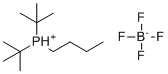 |
| Molecular Formula | C12H28BF4P |
| Molecular Weight | 290.13 |
| CAS Registry Number | 1816254-91-7 |
| EC Number | 813-732-8 |
| SMILES | [B-](F)(F)(F)F.CCCC[PH+](C(C)(C)C)C(C)(C)C |
| Hazard Symbols |

 GHS05;GHS07 Danger Details
 | ||||||||||||||||||||||||
|---|---|---|---|---|---|---|---|---|---|---|---|---|---|---|---|---|---|---|---|---|---|---|---|---|---|
| Hazard Statements | H302-H314 Details | ||||||||||||||||||||||||
| Precautionary Statements | P260-P280-P303+P361+P353-P301+P330+P331-P304+P340+P310-P305+P351+P338+P310 Details | ||||||||||||||||||||||||
| Hazard Classification | |||||||||||||||||||||||||
| |||||||||||||||||||||||||
| Transport Information | UN 1759 | ||||||||||||||||||||||||
| SDS | Available | ||||||||||||||||||||||||
 Discovory and Applicatios
|
n-Butyldi(tert-butyl)phosphonium tetrafluoroborate is a notable compound in the field of organophosphorus chemistry, valued for its unique properties and diverse applications. This chemical substance consists of a n-butyl group and two tert-butyl groups attached to a phosphorus atom, with tetrafluoroborate (BF4) serving as the counterion. The discovery of n-Butyldi(tert-butyl)phosphonium tetrafluoroborate emerged from ongoing research aimed at developing new types of ionic liquids and organophosphorus compounds. These compounds are sought for their distinct chemical properties, which include high stability, low volatility, and unique solvation abilities. The incorporation of bulky tert-butyl groups enhances the stability of the phosphonium cation and imparts desirable characteristics to the compound. The synthesis of n-Butyldi(tert-butyl)phosphonium tetrafluoroborate involves the reaction of n-butylphosphonium salts with tert-butyl groups and subsequent treatment with tetrafluoroboric acid or its salts. The resulting compound is characterized by its ionic nature, with the tetrafluoroborate ion providing stability and contributing to the overall properties of the substance. One of the primary applications of n-Butyldi(tert-butyl)phosphonium tetrafluoroborate is as a phase-transfer catalyst. In chemical synthesis, phase-transfer catalysis is used to facilitate reactions between substances in different phases, such as liquid and solid or liquid and gas. The bulky phosphonium cation in this compound enhances its ability to transfer ions between phases, making it an effective catalyst for various chemical reactions. In addition to phase-transfer catalysis, n-Butyldi(tert-butyl)phosphonium tetrafluoroborate has found use in electrochemical applications. Its ionic nature and stability make it suitable for use in ionic liquids and electrolytes. These applications leverage the compound's ability to conduct electricity and remain stable under different conditions, which is valuable in developing advanced materials and technologies. The compound also plays a role in material science. Its unique properties are exploited in the design and synthesis of new materials, including polymers and composites. The stability and solubility of n-Butyldi(tert-butyl)phosphonium tetrafluoroborate allow it to be incorporated into various material matrices, contributing to the development of innovative materials with tailored properties. Researchers have also explored its use in catalysis and synthesis of complex molecules. The bulky tert-butyl groups enhance the steric hindrance around the phosphorus atom, which can influence the reactivity and selectivity of reactions. This makes the compound useful in designing catalysts for specific transformations and improving reaction conditions. In summary, n-Butyldi(tert-butyl)phosphonium tetrafluoroborate represents a significant advancement in organophosphorus chemistry. Its discovery and development have provided chemists with a valuable tool for a range of applications, including phase-transfer catalysis, electrochemical processes, and material science. As research continues, this compound is expected to contribute further to advancements in these fields. |
| Market Analysis Reports |
| List of Reports Available for n-Butyldi(tert-butyl)phosphonium tetrafluoroborate |