
Online Database of Chemicals from Around the World
| Suzhou Biosyntech Co., Ltd. | China | |||
|---|---|---|---|---|
 | www.biosyntech-suzhou.com | |||
 | +86 13921151340 +86 (512) 6300-1269 | |||
 | sales2@biosyntech-suzhou.com sales@biosyntech-suzhou.com | |||
 | QQ Chat | |||
| Chemical distributor since 2019 | ||||
| chemBlink Standard supplier since 2020 | ||||
| Classification | Organic raw materials >> Alcohols, phenols, phenolic compounds and derivatives |
|---|---|
| Name | Salicyloyl phytosphingosine |
| Synonyms | 2-hydroxy-N-[(2S,3S,4R)-1,3,4-trihydroxyoctadecan-2-yl]benzamide |
| Molecular Structure | 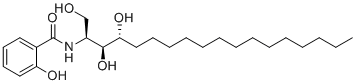 |
| Molecular Formula | C25H43NO5 |
| Molecular Weight | 437.61 |
| CAS Registry Number | 212908-67-3 |
| EC Number | 855-895-8 |
| SMILES | CCCCCCCCCCCCCC[C@H]([C@H]([C@H](CO)NC(=O)C1=CC=CC=C1O)O)O |
| Solubility | 0.087 mg/L (25 °C water) |
|---|---|
| Density | 1.1±0.1 g/cm3, Calc.* |
| Index of Refraction | 1.533, Calc.* |
| Melting point | 277.96 °C |
| Boiling Point | 639.92 °C, 675.2±55.0 °C (760 mmHg), Calc.* |
| Flash Point | 362.1±31.5 °C, Calc.* |
| * | Calculated using Advanced Chemistry Development (ACD/Labs) Software. |
| Hazard Symbols |  GHS07 Warning Details GHS07 Warning Details |
|---|---|
| Risk Statements | H302-H315-H319-H335 Details |
| Safety Statements | P280-P305+P351+P338 Details |
| SDS | Available |
 Discovery and Applications
|
Salicyloyl‑phytosphingosine is a synthetic sphingolipid derivative composed of a salicyloyl moiety covalently linked to the skin-identical sphingoid base Phytosphingosine. Its design capitalises on the combined benefits of salicylic acid (known for keratolytic and anti-inflammatory effects) and phytosphingosine (a naturally occurring component of ceramide and skin barrier lipids). The discovery of this compound emerged in the context of dermatological research into skin barrier repair and photoageing; investigators hypothesised that attaching a salicyloyl group to a sphingoid base might yield a molecule with enhanced biologic activity in skin repair and matrix regulation. An early study published in 2007 reported the formulation of salicyloyl-phytosphingosine (SP) and its effects on human fibroblasts and clinical periorbital wrinkle testing. ([PubMed][1]) In fibroblast cell culture, treatment with SP showed a significant increase in procollagen-I synthesis (approximately two-fold) and a reduction in the metalloproteinase MMP-1 levels compared to vehicle controls. In a small in vivo human study, topical application of 0.05% or 0.2% SP under occlusion for eight days induced increased deposition of dermal fibrillin-1 and procollagen-I, and reduced MMP-1 immunostaining in biopsy specimens of photoaged skin. Subsequent use in a four-week, half-face clinical study in women aged 41-69 years (n = 30) revealed statistically significant reductions in wrinkle depth and skin roughness (both Ra and Rz parameters) compared to placebo. These data supported the claim that SP could act as a “novel agent for the repair of photoaged skin”. ([Wiley Online Library][2]) In terms of application, SP is primarily employed in cosmetic and dermatological formulations as an active ingredient aimed at anti-ageing, skin barrier repair and modulation of extracellular matrix (ECM) markers. Its use extends into over-the-counter skincare products targeting lines and wrinkles, photo-damage and skin barrier enhancement. Although not a therapeutic drug in the regulatory sense, SP functions as a bioactive excipient with evidence of biologic activity in human skin. The combined salicyloyl and sphingolipid nature enables SP to influence skin barrier lipids, enhance ECM protein production and reduce proteolytic degradation of dermal matrix components. From a materials and formulation standpoint, SP is a lipophilic molecule with a long sphingoid chain linked to a salicylic acid derivative, and its solubility, stability and penetration properties have been described in cosmetic ingredient guides. Formulators highlight its use at low concentrations (~0.05-0.2%) owing to the potency of effects and its dual functional group design (phenolic hydroxyl of salicylic acid and multiple hydroxyls in the sphingoid base). Delivery systems often incorporate SP into oil-in-water emulsions, lipid carriers or micellar systems to optimise skin uptake and overcome its lipophilicity. Overall, salicyloyl-phytosphingosine exemplifies a deliberate chemical design in the skincare space: leveraging a skin-identical lipid backbone and a salicylic acid motif to produce a molecule that affects skin biology at multiple levels — barrier lipids, fibroblast ECM production, protease regulation and visible signs of photoageing. As evidence, the initial publication and subsequent usage support its value in formulation science and dermatological applications. References Farwick M, Watson REB, Rawlings AV, Wollenweber U, Lersch P, Bowden JJ, Bastrilles JY & Griffiths CEM (2007) Salicyloyl-phytosphingosine: a novel agent for the repair of photoaged skin. International Journal of Cosmetic Science 29(4) 319-329. DOI: 10.1111/j.1467-2494.2007.00394.x Kim BH, Lee JM, Jung YG, Kim S & Kim TY (2014) Phytosphingosine derivatives ameliorate skin inflammation by inhibiting NF-kappaB and JAK/STAT signaling in keratinocytes and mice. Journal of Investigative Dermatology 134(4) 1023-1032. DOI: 10.1038/jid.2013.453 Zhang X, Zhang X, Lin L, Wang K & Ji X-J (2024) Advances in the biosynthesis of tetraacetyl phytosphingosine, a key substrate of ceramides. Synthetic and Systems Biotechnology 10(1) 1-9. DOI: 10.1016/j.synbio.2024.07.005 |
| Market Analysis Reports |