
Online Database of Chemicals from Around the World
| Simagchem Corporation | China | |||
|---|---|---|---|---|
 | www.simagchem.com | |||
 | +86 13806087780 | |||
 | +86 (592) 268-0237 | |||
 | sale@simagchem.com | |||
| Chemical manufacturer since 2002 | ||||
| chemBlink Standard supplier since 2008 | ||||
| Survival Technologies Pvt Ltd | India | |||
|---|---|---|---|---|
| www.survivaltechnologies.in | |||
| +91 (22) 4212-8221 | |||
| +91 (22) 4212-8226 | |||
| info@survivaltechnologies.in | |||
| Chemical manufacturer since 2006 | ||||
| chemBlink Standard supplier since 2009 | ||||
| BOC Sciences | USA | |||
|---|---|---|---|---|
| www.bocsci.com | |||
| +1 (631) 485-4226 | |||
| +1 (631) 614-7828 | |||
| info@bocsci.com | |||
| Chemical manufacturer | ||||
| chemBlink Standard supplier since 2010 | ||||
| Beijing Huanling Technology Co., Ltd. | China | |||
|---|---|---|---|---|
| www.huanlingkeji.com | |||
| +86 (10) 5263-2489 | |||
| +86 (10) 5263-2489 | |||
| sales@huanlingkeji.com donghong1223@163.com | |||
 | QQ Chat | |||
| Chemical manufacturer since 2011 | ||||
| chemBlink Standard supplier since 2011 | ||||
| St-Jean Photochemicals Inc. | Canada | |||
|---|---|---|---|---|
| www.sjpc.com | |||
| +1 (450) 348-0901 | |||
| +1 (450) 349-1528 | |||
| info@sjpc.com | |||
| Chemical manufacturer | ||||
| Toronto Research Chemicals Inc. | Canada | |||
|---|---|---|---|---|
| www.trc-canada.com | |||
| +1 (416) 665-9696 | |||
| +1 (416) 665-4439 | |||
| info@trc-canada.com | |||
| Chemical manufacturer since 1982 | ||||
| Shanghai Worldyang Chemical Co., Ltd. | China | |||
|---|---|---|---|---|
| www.worldyachem.com | |||
| +86 13651600618 +86 (21) 5679-5779 | |||
| +86 (21) 5679-5266 | |||
| sales7777@worldyachem.com | |||
| QQ Chat | |||
 | WeChat: 13651600618 | |||
 | WhatsApp:+86 13651600618 | |||
| Chemical manufacturer since 2012 | ||||
| Classification | Organic raw materials >> Aryl compounds |
|---|---|
| Name | 9-Anthracenylmethyl methacrylate |
| Synonyms | anthracen-9-ylmethyl 2-methylprop-2-enoate |
| Molecular Structure | 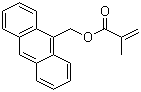 |
| Molecular Formula | C19H16O2 |
| Molecular Weight | 276.33 |
| CAS Registry Number | 31645-35-9 |
| EC Number | 636-528-9 |
| SMILES | CC(=C)C(=O)OCC1=C2C=CC=CC2=CC3=CC=CC=C31 |
| Melting point | 80-85 °C |
|---|---|
| Hazard Symbols |    GHS05;GHS07;GHS09 Danger Details GHS05;GHS07;GHS09 Danger Details | ||||||||||||||||||||||||||||
|---|---|---|---|---|---|---|---|---|---|---|---|---|---|---|---|---|---|---|---|---|---|---|---|---|---|---|---|---|---|
| Risk Statements | H315-H318-H319-H335-H411 Details | ||||||||||||||||||||||||||||
| Safety Statements | P261-P264-P264+P265-P271-P273-P280-P302+P352-P304+P340-P305+P351+P338-P305+P354+P338-P317-P319-P321-P332+P317-P337+P317-P362+P364-P391-P403+P233-P405-P501 Details | ||||||||||||||||||||||||||||
| Hazard Classification | |||||||||||||||||||||||||||||
| |||||||||||||||||||||||||||||
| SDS | Available | ||||||||||||||||||||||||||||
 Discovery and Applications
|
9-Anthracene methacrylate is a well-known organic compound that is primarily used in the fields of materials science and photochemistry. The synthesis of 9-Anthracene methacrylate involves the esterification of methacrylic acid with 9-anthracene methanol. The process typically utilizes a catalyst such as sulfuric acid or toluenesulfonyl chloride to promote the formation of an ester bond between the carboxyl group of methacrylic acid and the hydroxyl group of 9-anthracene methanol. Chemically, the compound consists of a methacrylate moiety attached to the 9-position of the anthracene ring system via a methylene bridge. The anthracene nucleus has a strong aromaticity that imparts its photophysical properties, while the methacrylate group allows for polymerization, thereby integrating the properties of anthracene into the polymer matrix. 9-Anthracene methacrylate is a crystalline solid that typically appears as a yellow powder due to the absorption of visible light by the conjugated anthracene system. Its structure has unique optical properties such as fluorescence that are useful for important applications such as photophysical studies and light absorption and emission. The main application of 9-Anthracene methacrylate is the photopolymerization process. When exposed to UV light, the anthracene moiety undergoes a photochemical reaction that initiates or enhances the polymerization of the methacrylate group. This property is used to create photoreactive polymers for use in coatings, adhesives, and optical devices. The compound is also used to synthesize fluorescent polymers. By incorporating 9-anthryl methacrylate into the polymer backbone, researchers can develop materials with intrinsic fluorescence. These polymers are valuable in applications such as bioimaging, sensors, and organic electronics, where fluorescence can be used to monitor processes or detect specific substances. In optoelectronics, 9-anthryl methacrylate has aided the development of OLEDs. The ability of the anthracene core to emit light when excited makes it suitable for creating light-emitting layers in OLED devices, improving their efficiency and color purity. The photoreactivity of 9-anthryl methacrylate can be used to design photodegradable polymers. These materials can be designed to degrade upon illumination, making them useful in applications that require controlled degradation, such as environmental cleanup or biomedical devices. Ongoing research explores new ways to utilize 9-anthryl methacrylate in advanced materials science. Research focuses on improving its photochemical efficiency, integrating it into new polymer systems, and developing new applications in photonics and optoelectronics. The versatility of this compound makes it a valuable tool for exploring the frontiers of materials science and technology. References 2013. Energy and electron transfer processes in polymeric nanoparticles. Photochemical & Photobiological Sciences, 12(12). DOI: 10.1039/c3pp50183c 1984. Copolymerization of 9-anthrylmethylmethacrylate with maleic anhydride. Polymer Bulletin, 11(6). DOI: 10.1007/bf01045329 1983. Intramolecular charge transfer complexes. Polymer Bulletin, 9(4-5). DOI: 10.1007/bf00265241 |
| Market Analysis Reports |