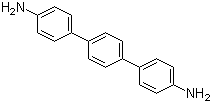
4,4''-Diamino-p-terphenyl, often referred to as DAPT, is an organic compound with the chemical formula C18H18N2. It consists of a p-terphenyl core, which is a triaryl compound featuring three phenyl groups, with two amino groups (-NH2) attached at the para positions of the outer phenyl rings. This compound was first synthesized in the mid-20th century during research into polycyclic aromatic compounds and their derivatives, which garnered significant interest for their electronic and optical properties.
The synthesis of 4,4''-diamino-p-terphenyl typically involves the nitration of p-terphenyl followed by reduction reactions. The introduction of amino groups enhances the compound's solubility and reactivity, making it valuable in various applications, particularly in materials science and organic electronics.
One of the primary applications of 4,4''-diamino-p-terphenyl is as a precursor for the production of high-performance polymers. Its structure provides excellent thermal stability and mechanical strength, making it suitable for applications in coatings, adhesives, and composites. These properties are particularly advantageous in aerospace and automotive industries, where materials must withstand extreme temperatures and mechanical stress.
In addition to its use in polymers, 4,4''-diamino-p-terphenyl has found applications in the field of organic electronics. It serves as an important building block for organic semiconductors, which are crucial for the development of flexible electronic devices, organic light-emitting diodes (OLEDs), and organic photovoltaic cells (OPVs). The compound's ability to facilitate charge transport due to its conjugated structure makes it a desirable candidate for these applications.
Research has also explored the potential of 4,4''-diamino-p-terphenyl in the development of novel dye-sensitized solar cells (DSSCs). The compound can be used to synthesize sensitizers that enhance light absorption and improve the overall efficiency of solar energy conversion. Its stability and electronic properties contribute to the advancement of renewable energy technologies.
Furthermore, 4,4''-diamino-p-terphenyl has been studied for its potential biological applications. Preliminary research suggests that it may exhibit antibacterial and antifungal properties, making it a candidate for pharmaceutical formulations. The compound's reactivity allows for further modifications that can enhance its therapeutic efficacy and target specificity.
Despite its diverse applications, handling 4,4''-diamino-p-terphenyl requires caution due to potential health risks associated with amines. Appropriate safety measures, including the use of personal protective equipment and proper ventilation, should be implemented when working with this compound in industrial and laboratory settings.
In summary, 4,4''-diamino-p-terphenyl is a versatile chemical compound with significant applications in materials science, organic electronics, and potentially in pharmaceuticals. Its discovery and subsequent utilization have contributed to advancements in various technological fields, particularly in the development of high-performance materials and devices.
References
none
|





 GHS07;GHS08 Danger Details
 Discovery and Applications