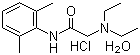
Lidocaine hydrochloride hydrate is a widely used local anesthetic of the amide type, employed to induce temporary loss of sensation in a specific area of the body. It works by blocking voltage-gated sodium channels in neuronal membranes, which prevents the initiation and conduction of nerve impulses, resulting in reversible local anesthesia. Lidocaine hydrochloride hydrate is the hydrated form of lidocaine hydrochloride, providing enhanced stability and solubility in aqueous solutions used for injection and topical applications.
Lidocaine was first synthesized in the early 1940s and introduced clinically soon after as an improvement over earlier local anesthetics like procaine. Lidocaine hydrochloride hydrate became a standard formulation due to its rapid onset of action and intermediate duration of effect. It is widely used in various medical fields including dentistry, surgery, and emergency medicine for local anesthesia, nerve blocks, and cardiac arrhythmia management.
The hydrochloride salt enhances lidocaine's water solubility, making it suitable for preparation in injectable solutions and topical gels or creams. The hydrate form includes water molecules in the crystal structure, which can improve stability during storage and handling. Lidocaine hydrochloride hydrate is commonly available in concentrations ranging from 0.5% to 5%, sometimes combined with vasoconstrictors such as epinephrine to prolong anesthetic effect and reduce systemic absorption.
Clinically, lidocaine hydrochloride hydrate is valued for its rapid onset, typically within 1 to 3 minutes after administration, and duration of action lasting approximately 30 minutes to 2 hours depending on dose, site of administration, and use of vasoconstrictors. It is applied in procedures such as minor surgical interventions, dental procedures, infiltration anesthesia, peripheral nerve blocks, and epidural anesthesia.
Pharmacokinetically, lidocaine is absorbed at varying rates depending on the administration site’s vascularity. It is widely distributed throughout the body and crosses the blood-brain and placental barriers. Lidocaine is metabolized primarily by the liver via cytochrome P450 enzymes to active and inactive metabolites, which are excreted mainly in the urine. The elimination half-life is approximately 1.5 to 2 hours in healthy adults.
Adverse effects may include local reactions such as redness, swelling, or numbness at the site of administration. Systemic toxicity can occur in cases of overdose or accidental intravascular injection, manifesting as central nervous system symptoms like dizziness, tinnitus, seizures, and cardiovascular effects such as hypotension, bradycardia, or arrhythmias. Proper dosing and administration techniques are essential to minimize risks.
Lidocaine hydrochloride hydrate is also used intravenously for the treatment of certain cardiac arrhythmias, particularly ventricular arrhythmias, due to its membrane-stabilizing effects on cardiac cells.
In summary, lidocaine hydrochloride hydrate is a fast-acting amide local anesthetic widely used for regional anesthesia and arrhythmia management. Its favorable pharmacokinetics, rapid onset, and intermediate duration, combined with improved stability in hydrated form, contribute to its broad clinical utility and established safety profile.
References
1979. Synthesis of Substituted 2‐Aminopyrrole Analogs of Lidocaine II. Journal of Pharmaceutical Sciences, 68(8).
DOI: 10.1002/jps.2600680810
1979. CYTOTOXIC EFFECTS OF PROCAINE, LIGNOCAINE AND BUPIVACAINE. British Journal of Anaesthesia, 51(4).
DOI: 10.1093/bja/51.4.273
1979. EFFECT OF I.V. ADMINISTRATION OF LIGNOCAINE AND TETRODOTOXIN ON SENSORY UNITS IN THE TOOTH OF THE CAT. British Journal of Anaesthesia, 51(6).
DOI: 10.1093/bja/51.6.487
|





 GHS06;GHS07 Danger Details
 Discovery and Applications