
Online Database of Chemicals from Around the World
| CAS: 638-11-9 Product: Isopropyl butanoate No suppliers available. |
| Classification | Flavors and spices >> Synthetic spice >> Carboxylic acid and ester perfume >> Aromatic carboxylic acid ester |
|---|---|
| Name | Isopropyl butanoate |
| Synonyms | 2-Propyl butanoate; Butanoic acid isopropyl ester; 1-Methylethyl butanoate; Isopropyl butyrate; Isopropyl n-butyrate |
| Molecular Structure | 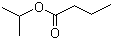 |
| Molecular Formula | C7H14O2 |
| Molecular Weight | 130.18 |
| CAS Registry Number | 638-11-9 |
| EC Number | 211-320-7 |
| SMILES | CCCC(=O)OC(C)C |
| Density | 0.9±0.1 g/cm3 Calc.*, 0.865 g/mL (Expl.) |
|---|---|
| Boiling point | 130.5 °C 760 mmHg (Calc.)*, 130 - 131 °C (Expl.) |
| Flash point | 30.0 °C (Calc.)* |
| Index of refraction | 1.404 (Calc.)*, 1.393 (Expl.) |
| * | Calculated using Advanced Chemistry Development (ACD/Labs) Software. |
| Hazard Symbols |   GHS02;GHS07 Warning Details GHS02;GHS07 Warning Details | ||||||||||||||||||||
|---|---|---|---|---|---|---|---|---|---|---|---|---|---|---|---|---|---|---|---|---|---|
| Risk Statements | H226-H315-H319-H335 Details | ||||||||||||||||||||
| Safety Statements | P210-P233-P240-P241-P242-P243-P261-P264-P264+P265-P271-P280-P302+P352-P303+P361+P353-P304+P340-P305+P351+P338-P319-P321-P332+P317-P337+P317-P362+P364-P370+P378-P403+P233-P403+P235-P405-P501 Details | ||||||||||||||||||||
| Hazard Classification | |||||||||||||||||||||
| |||||||||||||||||||||
| SDS | Available | ||||||||||||||||||||
 chemBlink Chemical Story
|
Isopropyl butanoate is an organic ester formed from the reaction between isopropyl alcohol and butanoic acid. It has the molecular formula C7H14O2 and is classified as a carboxylic acid ester. This compound is notable for its fruity aroma and is commonly found in flavor and fragrance applications. Isopropyl butanoate is typically synthesized through a Fischer esterification process, where isopropanol reacts with butanoic acid in the presence of an acid catalyst such as sulfuric acid. The reaction produces the ester and water as a byproduct. Alternative synthetic routes include transesterification and enzymatic catalysis. The compound is a colorless liquid at room temperature with moderate volatility and a characteristic sweet, fruity odor reminiscent of apple or pineapple. Due to these sensory properties, isopropyl butanoate is widely used as a flavoring agent in food products, beverages, and confectioneries to impart or enhance fruit-like flavors. In the fragrance industry, isopropyl butanoate serves as a component in perfumes, personal care products, and household items to provide fresh, fruity notes. Its volatility and pleasant scent make it suitable for blending with other aroma chemicals to achieve desired fragrance profiles. Isopropyl butanoate also finds application as a solvent in various industrial processes due to its moderate polarity and solvent capabilities. It is employed in coatings, inks, and adhesives where a balance of solvent strength and evaporation rate is required. The compound’s physical properties include a boiling point of approximately 110–115°C and limited solubility in water, but good miscibility with organic solvents such as ethanol and diethyl ether. Its density is less than water, contributing to its behavior in mixtures and formulations. Analytical techniques used to characterize isopropyl butanoate include gas chromatography (GC) for purity and composition analysis, mass spectrometry (MS) for molecular identification, and infrared (IR) spectroscopy to confirm ester functional groups. Nuclear magnetic resonance (NMR) spectroscopy is used to determine molecular structure and verify the position of functional groups. Regarding safety, isopropyl butanoate is generally regarded as safe in low concentrations used for flavoring and fragrance. However, it is flammable and should be handled with appropriate precautions to prevent fire hazards. Prolonged or excessive exposure may cause irritation to the skin, eyes, or respiratory tract. In summary, isopropyl butanoate is a fruity-smelling ester widely used in flavor and fragrance industries due to its pleasant aroma and moderate volatility. Synthesized mainly by esterification of isopropanol and butanoic acid, it also serves as a solvent in industrial applications. Its physical and chemical properties make it valuable for creating desirable sensory experiences in consumer products. References 2021. First-principle kinetic studies of unimolecular pyrolysis of isopropyl esters as biodiesel surrogates. Theoretical Chemistry Accounts, 140(7). DOI: 10.1007/s00214-021-02800-6 2021. Ab initio-based kinetics of hydrogen atom abstraction from methyl propionate by H and CH3 radicals: a biodiesel model. Structural Chemistry, 32(3). DOI: 10.1007/s11224-021-01746-6 2015. Contribution to Volatile Fingerprinting and Physico-chemical Qualities of Minimally Processed Durian cv. Monthong During Storage: Identification of a Novel Chemical Ripeness Marker. Food and Bioprocess Technology, 8(2). DOI: 10.1007/s11947-015-1486-z |
| Market Analysis Reports |