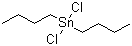
Dibutyltin dichloride (DBTDC) is an organotin compound with the molecular formula C₈H₁₈Cl₂Sn. It was first synthesized in the early 20th century, with significant contributions from researchers exploring the properties of tin compounds. Notably, the structure and reactivity of dibutyltin dichloride were elucidated in studies during the 1940s and 1950s, leading to its increased prominence in both research and industrial applications.
DBTDC is primarily recognized for its function as a versatile reagent in organic synthesis and catalysis. It serves as a key intermediate in the preparation of various organotin compounds, which find applications across multiple fields, including pharmaceuticals, agriculture, and materials science. Its ability to form stable complexes with various ligands makes it an essential tool in synthetic chemistry.
In organic synthesis, dibutyltin dichloride is employed as a catalyst for a variety of reactions, such as the polymerization of isocyanates and the synthesis of polyurethanes. Its catalytic properties facilitate the formation of complex organic structures, making it valuable in developing new materials. Additionally, DBTDC is utilized in the preparation of organotin derivatives, which possess unique properties suitable for various applications, including biocides and stabilizers.
One of the notable applications of dibutyltin dichloride lies in the field of polymer chemistry. It is often used as a stabilizer in the production of polyvinyl chloride (PVC) and other polymeric materials. By incorporating DBTDC into the formulation, manufacturers can enhance the thermal stability and durability of the final products. This application is particularly important in creating materials for construction, automotive, and consumer goods industries.
In agriculture, dibutyltin dichloride is recognized for its antifungal properties. It is used as a biocide in agricultural formulations to protect crops from various fungal pathogens. Its effectiveness in preventing fungal growth makes it a valuable component in agricultural practices, contributing to improved crop yields and quality.
Despite its beneficial applications, dibutyltin dichloride raises environmental and health concerns. Organotin compounds, including DBTDC, are known to exhibit toxic effects on aquatic life and may pose risks to human health. Consequently, regulatory measures are in place in many regions to limit its use and ensure safe handling practices in industrial settings.
In summary, dibutyltin dichloride is an important organotin compound with diverse applications in organic synthesis, polymer chemistry, and agriculture. Its unique properties and versatility make it a valuable reagent and catalyst in various industrial processes. However, awareness of its environmental and health implications is crucial, prompting ongoing research into safer alternatives and improved regulatory practices.
References
1968. Cyclic glycol ethers derived from dialkylstannanediols. Chemistry of Heterocyclic Compounds.
DOI: 10.1007/bf00664831
2023. New organotin(IV) complexes derived from 1-adamantanethiol: synthesis, crystal structure, DFT calculation, and in vitro antifungal activity and cytotoxicity. Transition Metal Chemistry.
DOI: 10.1007/s11243-023-00528-9
2022. Hollow-Fiber Liquid-Phase Micro-Extraction Method for the Simultaneous Derivatization, Extraction, and Pre-concentration of Organotin Compounds from Packed Fruit Juices. Food Analytical Methods.
DOI: 10.1007/s12161-022-02393-1
|






 GHS05;GHS06;GHS07;GHS08;GHS09 Danger Details
 chemBlink Chemical Story