
Online Database of Chemicals from Around the World
| Shanghai Rui Yun Chemical Technology Co., Ltd. | China | |||
|---|---|---|---|---|
 | www.rychemical.com.cn | |||
 | +86 (21) 6726-7633 | |||
 | +86 (21) 6726-7655 | |||
 | sales@rychemical.com.cn | |||
 | WeChat: 13917251563 | |||
| Chemical manufacturer since 2009 | ||||
| chemBlink Premium supplier since 2009 | ||||
| Classification | Organic raw materials >> Heterocyclic compound >> Indoles |
|---|---|
| Name | 5-Bromoindole-2-carboxylic acid |
| Synonyms | 5-bromo-1H-indole-2-carboxylic acid |
| Molecular Structure | 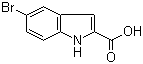 |
| Molecular Formula | C9H6BrNO2 |
| Molecular Weight | 240.05 |
| CAS Registry Number | 7254-19-5 |
| EC Number | 805-759-9 |
| SMILES | C1=CC2=C(C=C1Br)C=C(N2)C(=O)O |
| Melting point | 280 °C |
|---|---|
| Hazard Symbols |  GHS07 Warning Details GHS07 Warning Details | ||||||||||||||||||||||||||||||||
|---|---|---|---|---|---|---|---|---|---|---|---|---|---|---|---|---|---|---|---|---|---|---|---|---|---|---|---|---|---|---|---|---|---|
| Risk Statements | H302-H312-H315-H319-H332-H335 Details | ||||||||||||||||||||||||||||||||
| Safety Statements | P261-P264-P270-P271-P280-P301+P312-P302+P352-P304+P340-P305+P351+P338-P312-P330-P332+P313-P337+P313-P362-P363-P403+P233-P405-P501 Details | ||||||||||||||||||||||||||||||||
| Hazard Classification | |||||||||||||||||||||||||||||||||
| |||||||||||||||||||||||||||||||||
| SDS | Available | ||||||||||||||||||||||||||||||||
 chemBlink Chemical Story
|
5-Bromoindole-2-carboxylic acid is a heterocyclic organic compound characterized by the presence of both a bromine atom and a carboxyl group attached to the indole ring system. Its molecular formula is C₉H₆BrNO₂, and it features a bromine atom at the 5-position and a carboxyl group at the 2-position of the indole ring. The compound's unique structure imparts valuable properties for various applications in organic synthesis and medicinal chemistry. The synthesis of 5-bromoindole-2-carboxylic acid dates back to the mid-20th century, following advances in the chemistry of indole derivatives. The bromination of indole typically occurs at the 5-position using brominating agents, while the introduction of the carboxyl group is achieved through subsequent reactions such as carboxylation or hydrolysis of suitable intermediates. The development of efficient synthetic methods for this compound has facilitated its use in diverse chemical applications. One of the primary applications of 5-bromoindole-2-carboxylic acid is in organic synthesis, where it serves as a versatile building block for the preparation of various complex molecules. The presence of both the bromine and carboxyl groups enables further functionalization through various chemical reactions, including cross-coupling reactions such as Suzuki and Stille reactions. This versatility makes 5-bromoindole-2-carboxylic acid valuable in the synthesis of pharmaceuticals and agrochemicals. In medicinal chemistry, 5-bromoindole-2-carboxylic acid and its derivatives have been explored for their potential biological activities. The bromine atom enhances the molecule's reactivity and ability to interact with biological targets, making it a useful precursor for developing compounds with anti-cancer, anti-inflammatory, and antimicrobial properties. Research has demonstrated that derivatives of 5-bromoindole-2-carboxylic acid exhibit promising activity against various disease targets, contributing to its role in drug discovery. Moreover, 5-bromoindole-2-carboxylic acid is utilized in materials science for the synthesis of organic semiconductors and dyes. The compound's electronic properties, influenced by the indole ring and the presence of the bromine and carboxyl groups, make it suitable for applications in organic electronics and optoelectronic devices. Its derivatives are employed in the development of organic light-emitting diodes (OLEDs) and other advanced materials. In summary, 5-bromoindole-2-carboxylic acid is a valuable compound in both synthetic chemistry and medicinal research. Its unique structure allows for the creation of diverse chemical entities, contributing to advancements in drug development and materials science. References 2022. Novel MreB inhibitors with antibacterial activity against Gram (-) bacteria. Medicinal chemistry research : an international journal for rapid communications on design and mechanisms of action of biologically active agents, 31(10). DOI: 10.1007/s00044-022-02967-y 2004. Non-Peptidic Small-Molecule Inhibitors of the Single-Chain Hepatitis C Virus NS3 Protease/NS4A Cofactor Complex Discovered by Structure-Based NMR Screening. Journal of Medicinal Chemistry, 47(8). DOI: 10.1021/jm0305117 1991. Novel indole-2-carboxylates as ligands for the strychnine-insensitive N-methyl-D-aspartate-linked glycine receptor. Journal of Medicinal Chemistry, 34(4). DOI: 10.1021/jm00108a007 |
| Market Analysis Reports |