
Online Database of Chemicals from Around the World
| Zhejiang Yangfan New Materials Co., Ltd. | China | |||
|---|---|---|---|---|
 | www.shoufu.com | |||
 | +86 (571) 8890-2510 8890-2504 8890-2511 | |||
 | +86 (571) 8890-2500 | |||
 | shoufu@shoufuchem.com | |||
| Chemical manufacturer since 2002 | ||||
| chemBlink Standard supplier since 2006 | ||||
| Mascot I.E. CO.,Ltd. | China | |||
|---|---|---|---|---|
| www.mascotchem.com | |||
| +86 (519) 8501-0339 +86 13584504415 | |||
| +86 (519) 8501-0366 | |||
| info@mascotchem.com | |||
 | QQ Chat | |||
| Chemical distributor since 2006 | ||||
| chemBlink Standard supplier since 2006 | ||||
| Tianjin Jiuri Chemical Co., Ltd. | China | |||
|---|---|---|---|---|
| www.jiurichem.com | |||
| +86 (22) 5888-9229 | |||
| +86 (22) 5888-9249 | |||
| Jason@jiurichem.com | |||
| Chemical manufacturer since 1998 | ||||
| chemBlink Standard supplier since 2007 | ||||
| Simagchem Corporation | China | |||
|---|---|---|---|---|
| www.simagchem.com | |||
| +86 13806087780 | |||
| +86 (592) 268-0237 | |||
| sale@simagchem.com | |||
| Chemical manufacturer since 2002 | ||||
| chemBlink Standard supplier since 2008 | ||||
| Zhejiang Qiming Pharmaceutical Co., Ltd. | China | |||
|---|---|---|---|---|
| www.qimingpharm.com | |||
| +86 (571) 8716-3895 8716-3893 | |||
| +86 (571) 8716-3816 | |||
| sales@qimingpharm.com | |||
| QQ Chat | |||
| Chemical manufacturer | ||||
| chemBlink Standard supplier since 2009 | ||||
| Tianjin Zhongxin Chem-tech Co., Ltd. | China | |||
|---|---|---|---|---|
| www.tjzxchem.com | |||
| +86 (22) 6688-0623 | |||
| +86 (22) 8988-0739 ex 8030 | |||
| sales@tjzxchem.com | |||
| Chemical manufacturer since 2007 | ||||
| chemBlink Standard supplier since 2009 | ||||
| Hefei TNJ Chemical Industry Co., Ltd. | China | |||
|---|---|---|---|---|
| www.tnjchem.com | |||
| +86 (551) 6541-8684 | |||
| +86 (551) 6541-8697 | |||
| sales@tnjchem.com | |||
| Chemical manufacturer since 2001 | ||||
| chemBlink Standard supplier since 2010 | ||||
| BOC Sciences | USA | |||
|---|---|---|---|---|
| www.bocsci.com | |||
| +1 (631) 485-4226 | |||
| +1 (631) 614-7828 | |||
| info@bocsci.com | |||
| Chemical manufacturer | ||||
| chemBlink Standard supplier since 2010 | ||||
| Synasia Inc | USA | |||
|---|---|---|---|---|
| www.synasia.com | |||
| +1 (732) 205-9880 | |||
| +1 (732) 205-1788 | |||
| info@synasia.com | |||
| Chemical manufacturer | ||||
| chemBlink Standard supplier since 2011 | ||||
| Chembridge International Corp. Taipei / Dongguan / Nanjing | China | |||
|---|---|---|---|---|
| www.chembridge.com.tw | |||
| +886 (2) 2649-6320 +86 (769) 2250-4087 +86 (25) 8471-2192 | |||
| +886 (2) 2704-3915 / +86 (769) 2246-8225 / +86 (25) 8471-2052 | |||
| cnservice@chembridge.net | |||
| Chemical manufacturer | ||||
| chemBlink Standard supplier since 2011 | ||||
| Intatrade Chemicals GmbH | Germany | |||
|---|---|---|---|---|
| www.intatrade.de | |||
| +49 (3493) 605-465 | |||
| +49 (3493) 605-470 | |||
| sales@intatrade.de | |||
| Chemical distributor | ||||
| chemBlink Standard supplier since 2011 | ||||
| Anhui Royal Chemical Co., Ltd. | China | |||
|---|---|---|---|---|
| www.royal-chem.com | |||
| +86 (25) 8663-9253 | |||
| +86 (25) 5227-9193 | |||
| zoey.zhao@royal-chem.com | |||
| Chemical manufacturer since 2008 | ||||
| chemBlink Standard supplier since 2019 | ||||
| Bruhl Chemical Trade Inc. | USA | |||
|---|---|---|---|---|
| www.bch-bruehl.de | |||
| +1 (704) 713-7307 | |||
| sales@bch-bruehl.com | |||
| Chemical distributor since 2017 | ||||
| chemBlink Standard supplier since 2022 | ||||
| Riverland Trading LLC. | USA | |||
|---|---|---|---|---|
| www.riverlandtrading.com | |||
| +1 (336).944-2293 | |||
| bens@riverlandtrading.com | |||
| Chemical distributor | ||||
| chemBlink Standard supplier since 2023 | ||||
| Lift Chemical Technology Co., Ltd. | China | |||
|---|---|---|---|---|
| www.liftchem.com | |||
| +86 (22) 8834-5196 | |||
| sales@liftchem.com | |||
| Chemical distributor since 2023 | ||||
| chemBlink Standard supplier since 2023 | ||||
| Dalian Xueyuan Specialty Chemical Ltd. | China | |||
|---|---|---|---|---|
| www.daxuespecialchem.com | |||
| +86 (411) 8319-1498 | |||
| +86 (411) 8319-4098 | |||
| daxuespecialchem@yahoo.com | |||
| Chemical manufacturer | ||||
| Sinocure Chemical Group | China | |||
|---|---|---|---|---|
| www.sinocurechem.com | |||
| +86 15550440621 | |||
| info@sinocurechem.com | |||
| Chemical manufacturer since 2020 | ||||
| Yangzhong Jie You Chemical Co., Ltd. | China | |||
|---|---|---|---|---|
| www.jycchem.com | |||
| +86 (511) 8835-3088 | |||
| +86 (511) 8835-5816 | |||
| jycgroup@jycchem.com | |||
| Chemical manufacturer since 1985 | ||||
| Lianyungang Deyang Chemical Co., Ltd. | China | |||
|---|---|---|---|---|
| www.deychem.com | |||
| +86 (518) 8580-1622 | |||
| +86 (518) 8580-3622 | |||
| lydly@126.com | |||
| Chemical manufacturer since 2006 | ||||
| Classification | Organic raw materials >> Ketone compound |
|---|---|
| Name | 2-Hydroxy-2-methylpropiophenone |
| Synonyms | IHT-PI 1173; UV 1173 |
| Molecular Structure | 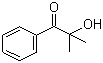 |
| Molecular Formula | C10H12O2 |
| Molecular Weight | 164.20 |
| CAS Registry Number | 7473-98-5 |
| EC Number | 231-272-0 |
| SMILES | CC(C)(C(=O)C1=CC=CC=C1)O |
| Density | 1.077 |
|---|---|
| Melting point | 4 °C |
| Boiling point | 80-81 °C |
| Refractive index | 1.533 |
| Flash point | 230 °F |
| Hazard Symbols |   GHS07;GHS09 Warning Details GHS07;GHS09 Warning Details | ||||||||||||||||||||||||||||||||||||||||||||
|---|---|---|---|---|---|---|---|---|---|---|---|---|---|---|---|---|---|---|---|---|---|---|---|---|---|---|---|---|---|---|---|---|---|---|---|---|---|---|---|---|---|---|---|---|---|
| Risk Statements | H302-H400-H410-H412 Details | ||||||||||||||||||||||||||||||||||||||||||||
| Safety Statements | P264-P270-P273-P301+P317-P330-P391-P501 Details | ||||||||||||||||||||||||||||||||||||||||||||
| Hazard Classification | |||||||||||||||||||||||||||||||||||||||||||||
| |||||||||||||||||||||||||||||||||||||||||||||
| SDS | Available | ||||||||||||||||||||||||||||||||||||||||||||
 chemBlink Chemical Story
|
2-Hydroxy-2-methylpropiophenone, with the chemical formula C₁₁H₁₂O₂, is a notable organic compound used in various industrial and research applications. This compound belongs to the family of hydroxyketones and is recognized for its utility as a photoinitiator in polymer chemistry. The compound was first synthesized and characterized in the mid-20th century as part of efforts to develop new photoinitiators for the polymerization of various monomers. Its synthesis involves the reaction of hydroxyacetone with acetophenone in the presence of appropriate catalysts, leading to the formation of 2-hydroxy-2-methylpropiophenone. One of the primary applications of 2-hydroxy-2-methylpropiophenone is in the field of ultraviolet (UV) curing. As a photoinitiator, it plays a crucial role in the polymerization of UV-curable resins. When exposed to UV light, 2-hydroxy-2-methylpropiophenone absorbs the radiation and initiates the polymerization process by generating free radicals. This makes it an essential component in the manufacturing of coatings, inks, adhesives, and other materials that require fast curing times and enhanced durability. In addition to its role in UV curing, 2-hydroxy-2-methylpropiophenone is used in the production of various types of polymerized films and coatings. Its efficiency as a photoinitiator contributes to the development of high-performance coatings with excellent resistance to abrasion, chemicals, and environmental factors. This makes it valuable in applications ranging from automotive finishes to electronic device coatings. Another significant application of 2-hydroxy-2-methylpropiophenone is in the field of dental materials. It is employed as a photoinitiator in dental resins and composites, where it helps in achieving rapid curing and enhancing the mechanical properties of the dental products. The compound's effectiveness in initiating polymerization ensures that dental materials can be quickly and efficiently hardened, providing reliable and long-lasting dental restorations. Moreover, 2-hydroxy-2-methylpropiophenone is used in research and development settings to study and optimize polymerization processes. Its ability to initiate polymerization upon UV exposure makes it a useful tool for scientists and engineers working on new materials and technologies. Overall, 2-hydroxy-2-methylpropiophenone's applications span various industries, highlighting its importance as a versatile and effective photoinitiator. Its contribution to UV curing, dental materials, and polymer research underscores its value in advancing material science and technology. References 2024. Preparation and properties of waterborne UV-curable epoxy soybean oil acrylate resin. Journal of Coatings Technology and Research, 21(6). DOI: 10.1007/s11998-024-01020-4 2024. Dynamic Schiff base linkage-based double-network hydrogels with injectable, self-healing, and pH-responsive properties for bacteria-infected wound healing. Cellulose, 31(8). DOI: 10.1007/s10570-024-05972-z 1982. Chemical polarization of nuclei and mechanism of photolysis of α-hydroxyketones. Bulletin of the Academy of Sciences of the USSR, Division of chemical science, 31(3). DOI: 10.1007/bf00949760 |
| Market Analysis Reports |