
Online Database of Chemicals from Around the World
| Jinan Orgachem Technology and Development Co., Ltd. | China | |||
|---|---|---|---|---|
 | www.orgachem.com | |||
 | +86 (531) 8268-7809 8268-7823 8268-7819 | |||
 | +86 (531) 8268-7807 | |||
 | dzgdshyq@163.com | |||
| Chemical manufacturer | ||||
| chemBlink Standard supplier since 2007 | ||||
| Simagchem Corporation | China | |||
|---|---|---|---|---|
| www.simagchem.com | |||
| +86 13806087780 | |||
| +86 (592) 268-0237 | |||
| sale@simagchem.com | |||
| Chemical manufacturer since 2002 | ||||
| chemBlink Standard supplier since 2008 | ||||
| Arshine Technology Co., Ltd. | China | |||
|---|---|---|---|---|
| www.arshine.com.cn | |||
| +86 (755) 3333-0822 | |||
| +86 (755) 8287-9323 | |||
| marketing@arshine.com.cn | |||
| Chemical manufacturer | ||||
| chemBlink Standard supplier since 2010 | ||||
| Hefei TNJ Chemical Industry Co., Ltd. | China | |||
|---|---|---|---|---|
| www.tnjchem.com | |||
| +86 (551) 6541-8684 | |||
| +86 (551) 6541-8697 | |||
| sales@tnjchem.com | |||
| Chemical manufacturer since 2001 | ||||
| chemBlink Standard supplier since 2010 | ||||
| Jinan Dechenghemu Medical Technology Co., Ltd. | China | |||
|---|---|---|---|---|
| www.jndcyy.com | |||
| +86 (531) 8888-3739 | |||
| +86 (531) 6232-5949 | |||
| dcyy@vip.sina.com | |||
| Chemical manufacturer | ||||
| chemBlink Standard supplier since 2010 | ||||
| SL Drugs and Pharmaceuticals Pvt. Ltd. | India | |||
|---|---|---|---|---|
| www.sldrugs.com | |||
| +91 (40) 6661-1133 | |||
| +91 (40) 2375-1130 | |||
| enquiry@sldrugs.com | |||
| Chemical distributor since 1999 | ||||
| chemBlink Standard supplier since 2010 | ||||
| BOC Sciences | USA | |||
|---|---|---|---|---|
| www.bocsci.com | |||
| +1 (631) 485-4226 | |||
| +1 (631) 614-7828 | |||
| info@bocsci.com | |||
| Chemical manufacturer | ||||
| chemBlink Standard supplier since 2010 | ||||
| Hangzhou Leap Chem Co., Ltd. | China | |||
|---|---|---|---|---|
| www.leapchem.com | |||
| +86 (571) 8771-1850 | |||
| market19@leapchem.com | |||
 | QQ Chat | |||
| Chemical manufacturer since 2006 | ||||
| chemBlink Standard supplier since 2015 | ||||
| Turtle Pharma Private Limited | India | |||
|---|---|---|---|---|
| www.turtlepharma.com | |||
| +91 9850998504 | |||
| info@turtlepharma.com | |||
| Chemical manufacturer since 2015 | ||||
| chemBlink Standard supplier since 2024 | ||||
| LKT Laboratories, Inc. | USA | |||
|---|---|---|---|---|
| www.lktlabs.com | |||
| +1 (888) 558-5227 | |||
| +1 (651) 644-8357 | |||
| peacerli@mbolin-lktlabs.com | |||
| Chemical manufacturer | ||||
| Zhejiang Langhua Pharmaceutical Co., Ltd. | China | |||
|---|---|---|---|---|
| www.langhuapharma.com | |||
| +86 (576) 8558-8383 8558-8460 | |||
| +86 (576) 8558-8213 / 8558-8383 | |||
| sales@langhuapharma.com zjg@langhuapharma.com | |||
| Chemical manufacturer since 1986 | ||||
| Aronis | Russia | |||
|---|---|---|---|---|
| www.aronis.ru | |||
| +7 (926) 578-0336 | |||
| +7 (495) 426-5336 | |||
| rakishev@aronis.ru | |||
| Chemical manufacturer | ||||
| Classification | API >> Antibiotics >> Other antibiotics |
|---|---|
| Name | Ciprofloxacin hydrochloride hydrate |
| Synonyms | 1-Cyclopropyl-6-fluoro-1,4-dihydro-4-oxo-7-(1-piperazinyl)-3-quinolinecarboxylic acid hydrochloride hydrate |
| Molecular Structure | 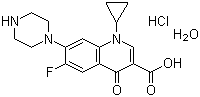 |
| Molecular Formula | C17H18FN3O3.HCl.H2O |
| Molecular Weight | 385.82 |
| CAS Registry Number | 86393-32-0 |
| EC Number | 617-845-1 |
| SMILES | C1CC1N2C=C(C(=O)C3=CC(=C(C=C32)N4CCNCC4)F)C(=O)O.O.Cl |
| Melting point | 318-320 °C |
|---|---|
| Hazard Symbols |  GHS07 Warning Details GHS07 Warning Details | ||||||||||||||||||||||||||||||||||||||||||||||||||||||||||||||||||||||||||||||||||||||||
|---|---|---|---|---|---|---|---|---|---|---|---|---|---|---|---|---|---|---|---|---|---|---|---|---|---|---|---|---|---|---|---|---|---|---|---|---|---|---|---|---|---|---|---|---|---|---|---|---|---|---|---|---|---|---|---|---|---|---|---|---|---|---|---|---|---|---|---|---|---|---|---|---|---|---|---|---|---|---|---|---|---|---|---|---|---|---|---|---|---|
| Risk Statements | H317-H319-H335-H412 Details | ||||||||||||||||||||||||||||||||||||||||||||||||||||||||||||||||||||||||||||||||||||||||
| Safety Statements | P261-P264+P265-P271-P272-P273-P280-P302+P352-P304+P340-P305+P351+P338-P319-P321-P333+P317-P337+P317-P362+P364-P403+P233-P405-P501 Details | ||||||||||||||||||||||||||||||||||||||||||||||||||||||||||||||||||||||||||||||||||||||||
| Hazard Classification | |||||||||||||||||||||||||||||||||||||||||||||||||||||||||||||||||||||||||||||||||||||||||
| |||||||||||||||||||||||||||||||||||||||||||||||||||||||||||||||||||||||||||||||||||||||||
| SDS | Available | ||||||||||||||||||||||||||||||||||||||||||||||||||||||||||||||||||||||||||||||||||||||||
 chemBlink Chemical Story
|
Ciprofloxacin hydrochloride hydrate is a potent antibiotic widely used in clinical settings to treat a variety of bacterial infections. It is the hydrated hydrochloride salt form of ciprofloxacin, a second-generation fluoroquinolone, which was developed in the early 1980s by Bayer AG, a German pharmaceutical company. Ciprofloxacin hydrochloride hydrate retains the same broad-spectrum antibacterial activity as its parent compound, making it an important therapeutic agent in the fight against both Gram-negative and Gram-positive bacterial infections. Ciprofloxacin hydrochloride hydrate works by inhibiting bacterial DNA gyrase and topoisomerase IV, enzymes crucial for DNA replication, transcription, and repair in bacteria. By blocking these enzymes, ciprofloxacin prevents bacterial cells from proliferating, leading to their death. This mechanism of action makes ciprofloxacin effective against a wide range of bacterial pathogens, including those that cause respiratory tract infections, urinary tract infections (UTIs), gastrointestinal infections, and skin infections. The discovery of ciprofloxacin hydrochloride hydrate was part of a broader effort to enhance the solubility and stability of ciprofloxacin, which in its pure form can be difficult to formulate effectively. The hydrochloride hydrate form improves the drug's solubility in water, making it more suitable for both oral and intravenous formulations. This enhanced solubility is particularly beneficial for intravenous administration, where high concentrations of the drug in solution are required for effective treatment of severe infections. Ciprofloxacin hydrochloride hydrate was first approved by the U.S. Food and Drug Administration (FDA) in the late 1980s, following the approval of ciprofloxacin. It quickly became a widely prescribed antibiotic due to its effectiveness, favorable pharmacokinetic properties, and the ability to treat a broad spectrum of infections. The hydrate form of ciprofloxacin is used in various formulations, including oral tablets, oral suspensions, and intravenous solutions, providing flexibility in how the drug can be administered based on the severity and location of the infection. One of the primary applications of ciprofloxacin hydrochloride hydrate is in the treatment of complicated UTIs, including pyelonephritis, where it is highly effective against common causative pathogens like Escherichia coli and Klebsiella pneumoniae. It is also frequently used to treat lower respiratory tract infections, such as bronchitis and pneumonia, particularly in cases where the infection is caused by resistant bacteria. Additionally, ciprofloxacin hydrochloride hydrate is effective against skin and soft tissue infections, bone and joint infections, and certain types of gastrointestinal infections, including those caused by Salmonella and Shigella species. Despite its widespread use, the overuse and misuse of ciprofloxacin hydrochloride hydrate have contributed to the growing problem of antibiotic resistance. Bacteria can develop resistance to ciprofloxacin through various mechanisms, including mutations in the genes encoding DNA gyrase and topoisomerase IV or by enhancing drug efflux systems that pump the antibiotic out of bacterial cells. This has led to calls for more prudent use of ciprofloxacin and other fluoroquinolones, reserving them for infections where they are truly needed and where other antibiotics are less effective. Ciprofloxacin hydrochloride hydrate is generally well-tolerated, but it is not without side effects. Common adverse effects include gastrointestinal symptoms such as nausea, diarrhea, and abdominal pain. More serious, though less common, side effects include tendonitis, tendon rupture, and central nervous system effects like seizures and hallucinations. Due to these risks, the use of ciprofloxacin hydrochloride hydrate is often avoided in children, pregnant women, and elderly patients unless absolutely necessary. In conclusion, ciprofloxacin hydrochloride hydrate remains a critical antibiotic in modern medicine, particularly for the treatment of severe and resistant bacterial infections. Its discovery and development have significantly expanded the therapeutic options available for managing a wide range of infections, although careful use is required to minimize the risk of resistance and adverse effects. References 1991. Ciprofloxacin as an effective antibacterial agent in serratia endocarditis. The Journal of Infection, 22(1). DOI: 10.1016/0163-4453(91)91346-y 1991. Successful Treatment of Cat-scratch Disease With Ciprofloxacin. JAMA: The Journal of the American Medical Association, 265(12). DOI: 10.1001/jama.1991.03460120077039 1987. The adverse effects of fluoroquinolones. The Journal of Antimicrobial Chemotherapy, 19(6). DOI: 10.1093/jac/19.6.709 |
| Market Analysis Reports |