
Online Database of Chemicals from Around the World
| Alway Chem, China | China | |||
|---|---|---|---|---|
 | www.alwaychem.net | |||
 | +86 (532) 8586-4000 | |||
 | +86 (532) 8589-3133 | |||
 | alwaychem@gmail.com alwaychem@hotmail.com | |||
| Chemical manufacturer | ||||
| chemBlink Standard supplier since 2006 | ||||
| Simagchem Corporation | China | |||
|---|---|---|---|---|
| www.simagchem.com | |||
| +86 13806087780 | |||
| +86 (592) 268-0237 | |||
| sale@simagchem.com | |||
| Chemical manufacturer since 2002 | ||||
| chemBlink Standard supplier since 2008 | ||||
| Hefei TNJ Chemical Industry Co., Ltd. | China | |||
|---|---|---|---|---|
| www.tnjchem.com | |||
| +86 (551) 6541-8684 | |||
| +86 (551) 6541-8697 | |||
| sales@tnjchem.com | |||
| Chemical manufacturer since 2001 | ||||
| chemBlink Standard supplier since 2010 | ||||
| Winchem Industrial Co., Ltd. | China | |||
|---|---|---|---|---|
| www.win-chemical.com | |||
| +86 (574) 8385-1061 | |||
| +86 (574) 8708-3209 | |||
| info@win-chemical.com hhp13@hotmail.com | |||
| Chemical manufacturer | ||||
| chemBlink Standard supplier since 2010 | ||||
| BOC Sciences | USA | |||
|---|---|---|---|---|
| www.bocsci.com | |||
| +1 (631) 485-4226 | |||
| +1 (631) 614-7828 | |||
| info@bocsci.com | |||
| Chemical manufacturer | ||||
| chemBlink Standard supplier since 2010 | ||||
| Hangzhou Mole's Science&Technology Co., Ltd. | China | |||
|---|---|---|---|---|
| www.mole-scitech.com | |||
| +86 (571) 5688-0228 | |||
| +86 (571) 5685-4558 | |||
| amy@mole-scitech.com | |||
| Chemical manufacturer | ||||
| chemBlink Standard supplier since 2011 | ||||
| Hangzhou Chuan Shuo Technology Co., Ltd. | China | |||
|---|---|---|---|---|
| www.transol.cn | |||
| +86 (571) 8760-9021 | |||
| qian@transol.cn | |||
| Chemical manufacturer since 2017 | ||||
| chemBlink Standard supplier since 2025 | ||||
| J & W PharmLab LLC | USA | |||
|---|---|---|---|---|
| www.jwpharmlab.com | |||
| +1 (215) 945-6595 | |||
| +1 (215) 945-6597 | |||
| services@jwpharmlab.com | |||
| Chemical manufacturer | ||||
| Classification | Organic raw materials >> Amino compound |
|---|---|
| Name | 2,5-Diaminotoluene |
| Synonyms | 2-Methyl-1,4-benzenediamine; Toluene-2,5-diamine |
| Molecular Structure | 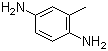 |
| Molecular Formula | C7H10N2 |
| Molecular Weight | 122.17 |
| CAS Registry Number | 95-70-5 |
| EC Number | 202-442-1 |
| SMILES | CC1=C(C=CC(=C1)N)N |
| Density | 1.1±0.1 g/cm3 Calc.* |
|---|---|
| Melting point | 64 °C (Expl.) |
| Boiling point | 273.7±20.0 °C 760 mmHg (Calc.)*, 273.5 °C (Expl.) |
| Flash point | 140.6±21.3 °C (Calc.)* |
| Index of refraction | 1.636 (Calc.)* |
| * | Calculated using Advanced Chemistry Development (ACD/Labs) Software. |
| Hazard Symbols |   GHS06;GHS09 Danger Details GHS06;GHS09 Danger Details | ||||||||||||||||||||||||||||||||||||||||||||||||||||
|---|---|---|---|---|---|---|---|---|---|---|---|---|---|---|---|---|---|---|---|---|---|---|---|---|---|---|---|---|---|---|---|---|---|---|---|---|---|---|---|---|---|---|---|---|---|---|---|---|---|---|---|---|---|
| Risk Statements | H301-H312:-H317:-H332:-H411: Details | ||||||||||||||||||||||||||||||||||||||||||||||||||||
| Safety Statements | P261-P264-P270-P271-P272-P273-P280-P301+P316-P302+P352-P304+P340-P317-P321-P330-P333+P317-P362+P364-P391-P405-P501 Details | ||||||||||||||||||||||||||||||||||||||||||||||||||||
| Hazard Classification | |||||||||||||||||||||||||||||||||||||||||||||||||||||
| |||||||||||||||||||||||||||||||||||||||||||||||||||||
| SDS | Available | ||||||||||||||||||||||||||||||||||||||||||||||||||||
 chemBlink Chemical Story
|
2,5-Diaminotoluene is an aromatic organic compound characterized by a benzene ring substituted with two amino groups (–NH2) at the 2- and 5-positions and a methyl group (–CH3) at the 1-position, which corresponds to the toluene moiety. The molecular formula of this compound is C7H10N2. It belongs to the class of diaminotoluenes, compounds notable for their use in dye and chemical industries. The compound has been known and utilized since the early 20th century, especially due to its role as an intermediate in the manufacture of hair dyes and pigments. 2,5-Diaminotoluene is typically synthesized via the selective reduction or amination of dinitrotoluene derivatives or through nitration followed by catalytic hydrogenation of toluene-based precursors, allowing for the controlled introduction of amino groups at specific positions on the aromatic ring. Its primary application is in the cosmetics industry, particularly as a key component in oxidative hair dye formulations. The presence of two amino groups facilitates its oxidation and coupling reactions with other dye precursors, producing a range of permanent hair colors. Compared to related compounds, 2,5-diaminotoluene offers advantageous color properties and reduced allergenic potential, which has made it a preferred ingredient in many commercial hair dye products. Beyond hair dyes, 2,5-diaminotoluene is used in the synthesis of pigments, rubber chemicals, and certain pharmaceuticals. Its reactivity allows it to serve as a building block in the manufacture of azo dyes, which are widely employed for textile coloration due to their vivid and stable colors. Analytical characterization of 2,5-diaminotoluene involves nuclear magnetic resonance (NMR) spectroscopy to confirm substitution patterns on the aromatic ring and the presence of amino and methyl groups. Infrared (IR) spectroscopy detects characteristic N–H stretching vibrations from the amino groups and aromatic C–H stretches. High-performance liquid chromatography (HPLC) and mass spectrometry (MS) are also utilized for purity assessment and molecular identification. From a chemical safety perspective, 2,5-diaminotoluene should be handled with caution as aromatic amines may present toxicity and sensitization risks. Protective measures include the use of gloves, eye protection, and adequate ventilation to prevent inhalation of dust or vapors. Regulatory guidelines often limit its concentration in consumer products to minimize health risks. In summary, 2,5-diaminotoluene is a well-established aromatic diamine primarily employed in hair dye formulations and pigment synthesis. Its selective synthesis routes, functional versatility, and analytical methods support its widespread industrial application, while adherence to safety protocols ensures responsible handling in manufacturing and product use. References 2023. Haarfärbemittel verursachen Kontaktdermatitis. Allergo Journal. DOI: 10.1007/s15007-023-5837-1 2021. Common Allergens. Clinical Contact Dermatitis. DOI: 10.1007/978-3-030-49332-5_22 2020. Contact Allergy to Hair Dyes. Contact Dermatitis. DOI: 10.1007/978-3-030-36335-2_90 |
| Market Analysis Reports |