
Online Database of Chemicals from Around the World
| RC Chemicals Lab Inc | USA | |||
|---|---|---|---|---|
 | www.rcchemicallabs.net | |||
 | +1 (401) 232-4508 | |||
 | info@rcchemicallabs.net | |||
| Chemical distributor since 2010 | ||||
| chemBlink Standard supplier since 2025 | ||||
| Classification | Pharmaceutical intermediate >> Heterocyclic compound intermediate >> Pyrimidine compound >> Amine |
|---|---|
| Name | 2-Fluoromethamphetamine |
| Synonyms | 1-(2-fluorophenyl)-N-methylpropan-2-amine |
| Molecular Structure | 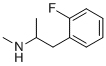 |
| Molecular Formula | C10H14FN |
| Molecular Weight | 167.22 |
| CAS Registry Number | 1017176-48-5 |
| SMILES | CC(CC1=CC=CC=C1F)NC |
| Density | 1.0±0.1 g/cm3 Calc.* |
|---|---|
| Boiling point | 217.3±15.0 °C 760 mmHg (Calc.)* |
| Flash point | 85.2±20.4 °C (Calc.)* |
| Index of refraction | 1.488 (Calc.)* |
| * | Calculated using Advanced Chemistry Development (ACD/Labs) Software. |
 chemBlink Chemical Story
|
2-Fluoromethamphetamine is a synthetic psychoactive substance belonging to the substituted amphetamine family. Its discovery is closely linked to the broader historical development of amphetamine and methamphetamine derivatives, which began in the early twentieth century with efforts to modify phenethylamine structures in order to alter pharmacological potency, duration of action, and selectivity. Fluorinated analogues such as 2-fluoromethamphetamine emerged primarily from medicinal chemistry research exploring how halogen substitution on the aromatic ring affects central nervous system activity, metabolic stability, and blood–brain barrier penetration. The parent compound methamphetamine was first synthesized in the late nineteenth century and later widely studied for its stimulant properties. Subsequent decades saw systematic structural modifications of the amphetamine scaffold, including substitution at the aromatic ring, side chain, or amine nitrogen. Introduction of a fluorine atom was of particular interest to chemists because fluorine is similar in size to hydrogen but highly electronegative, often producing significant changes in receptor binding and metabolic pathways without drastically altering molecular size. In the case of 2-fluoromethamphetamine, the fluorine atom is located at the ortho position of the phenyl ring, a placement known to influence steric interactions and conformational preferences. The initial synthesis of ring-fluorinated amphetamines, including 2-fluoromethamphetamine, was reported in the scientific literature as part of broader investigations into structure–activity relationships of sympathomimetic amines. These studies typically aimed to understand how positional isomers differ in stimulant, anorectic, or psychoactive effects. In controlled laboratory settings, compounds such as 2-fluoromethamphetamine were evaluated using animal models to assess locomotor stimulation, neurotransmitter release, and toxicity relative to methamphetamine and other analogues. Pharmacological research indicates that 2-fluoromethamphetamine acts primarily as a monoamine releasing agent, increasing extracellular concentrations of dopamine, norepinephrine, and serotonin by interacting with their respective transporters. The ortho-fluoro substitution appears to modulate the balance of monoamine release compared with unsubstituted methamphetamine, although the precise quantitative differences depend on experimental conditions and assay systems. Like other amphetamine derivatives, its central effects are associated with stimulation, increased alertness, and sympathomimetic activity, while peripheral effects may include elevated heart rate and blood pressure. Unlike compounds developed for approved medical use, 2-fluoromethamphetamine did not progress through formal clinical development. Instead, it became known primarily through its appearance in the context of so-called new psychoactive substances in the early twenty-first century. Advances in analytical chemistry, particularly gas chromatography–mass spectrometry and liquid chromatography–tandem mass spectrometry, enabled forensic and toxicological laboratories to identify this compound in seized materials and biological samples. Its detection highlighted the ongoing trend of minor chemical modifications being used to create novel substances with psychoactive properties. The application of 2-fluoromethamphetamine has therefore been largely confined to non-medical contexts, including forensic science, toxicology, and regulatory assessment. Analytical reference standards have been developed to support identification and quantification in seized drugs and postmortem investigations. Studies in this area have focused on characterizing its fragmentation patterns, metabolism, and distinguishing features relative to closely related fluorinated amphetamines such as 3-fluoromethamphetamine and 4-fluoromethamphetamine. From a regulatory and public health perspective, the emergence of 2-fluoromethamphetamine contributed to discussions on how to control entire classes of structurally related substances rather than individual compounds. Its discovery and subsequent monitoring illustrate how relatively small chemical changes can produce new psychoactive agents that challenge existing legal frameworks. Overall, 2-fluoromethamphetamine is best understood as a product of systematic chemical modification of the amphetamine structure, with its significance lying more in scientific, forensic, and regulatory domains than in therapeutic application. References Brandt SD, Sumnall HR, Measham F, Cole J (2010) Analyses of second generation legal highs in the UK: initial findings. *Drug Testing and Analysis* 2(8) 377–382 DOI: 10.1002/dta.155 |
| Market Analysis Reports |