
Online Database of Chemicals from Around the World
| Wuhan Kemi-works Chemical Co., Ltd. | China | |||
|---|---|---|---|---|
 | www.kemiworks.net | |||
 | +86 (27) 8573-6489 | |||
 | +86 (27) 8573-6485 | |||
 | info@kemiworks.net sales@kemiworks.com | |||
| Chemical manufacturer | ||||
| chemBlink Premium supplier since 2011 | ||||
| Classification | Organic raw materials >> Organometallic compound >> Organic germanium, cobalt, strontium, barium, gallium, germanium, germanium, germanium, germanium, etc. |
|---|---|
| Name | Tin(II) tetrafluoroborate |
| Synonyms | Tin fluoroborate; Tin(II) borofluoride |
| Molecular Structure | 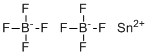 |
| Molecular Formula | Sn.(BF4)2 |
| Molecular Weight | 292.30 |
| CAS Registry Number | 13814-97-6 |
| EC Number | 237-487-6 |
| SMILES | [B-](F)(F)(F)F.[B-](F)(F)(F)F.[Sn+2] |
| Density | 1.67 |
|---|---|
| Hazard Symbols |   GHS05;GHS07 Warning Details GHS05;GHS07 Warning Details | ||||||||||||||||||||||||
|---|---|---|---|---|---|---|---|---|---|---|---|---|---|---|---|---|---|---|---|---|---|---|---|---|---|
| Risk Statements | H290-H302-H317-H319 Details | ||||||||||||||||||||||||
| Safety Statements | P234-P261-P264-P264+P265-P270-P272-P280-P301+P317-P302+P352-P305+P351+P338-P321-P330-P333+P317-P337+P317-P362+P364-P390-P406-P501 Details | ||||||||||||||||||||||||
| Hazard Classification | |||||||||||||||||||||||||
| |||||||||||||||||||||||||
| Transport Information | UN 3264 | ||||||||||||||||||||||||
| SDS | Available | ||||||||||||||||||||||||
 chemBlink Chemical Story
|
Tin(II) tetrafluoroborate, with the chemical formula Sn(BF4)2, is an inorganic compound that is a salt of tin and tetrafluoroboric acid. This substance has garnered attention in the field of chemistry due to its unique properties and its potential applications in both industrial processes and research. The discovery of tin(II) tetrafluoroborate can be traced back to the study of tin salts and their reactions with tetrafluoroboric acid, a strong fluorinating agent. This compound was first synthesized and characterized as part of the ongoing exploration of metal-fluorine interactions, which are of significant interest for a range of chemical applications. The synthesis of tin(II) tetrafluoroborate typically involves reacting tin(II) chloride (SnCl2) with tetrafluoroboric acid (HBF4) or tetrafluoroborate salts in a suitable solvent. The reaction results in the formation of the desired tin(II) salt, which is typically obtained in crystalline form. The process is straightforward and produces a compound that is relatively stable under ambient conditions. The structure of tin(II) tetrafluoroborate consists of Sn(II) ions coordinated to two tetrafluoroborate (BF4-) anions, giving the compound its characteristic stability and solubility in polar solvents like water and acetonitrile. One of the most significant applications of tin(II) tetrafluoroborate is its use in organic synthesis, particularly as a mild reducing agent. Tin(II) salts are known for their ability to reduce various organic compounds, and tin(II) tetrafluoroborate is no exception. It has been utilized in reactions such as the reduction of nitro compounds to amines, a critical step in the synthesis of pharmaceuticals and agrochemicals. Its ability to selectively reduce certain functional groups without affecting others makes it a valuable reagent in organic synthesis, offering a high degree of control over reaction outcomes. In addition to its role as a reducing agent, tin(II) tetrafluoroborate is also used in the field of electrochemistry. It has been studied for its potential as an electrolyte in electrochemical cells, particularly in systems that require the use of a stable, non-corrosive electrolyte. The compound’s ability to dissociate into Sn(II) and BF4- ions in solution allows it to facilitate electron transfer processes, which are essential for electrochemical reactions. This application is particularly useful in the development of advanced battery technologies, where stable and efficient electrolytes are crucial for the performance of the system. Another important application of tin(II) tetrafluoroborate is in catalysis, where it is used as a catalyst or catalyst precursor in various chemical reactions. It has been found to catalyze reactions such as the polymerization of certain monomers, leading to the production of high-performance polymers. Its role as a catalyst is enhanced by the stability of the tetrafluoroborate anion, which allows for efficient catalytic cycles in both homogeneous and heterogeneous catalytic processes. This makes tin(II) tetrafluoroborate a useful material in the production of specialized materials, coatings, and films. Furthermore, the compound has potential applications in the field of materials science, where it may be used in the preparation of tin-based materials for use in electronic devices. Its ability to interact with various substrates and its solubility in polar solvents makes it a candidate for the synthesis of thin films and other advanced materials that are important for electronics and optoelectronics. Despite its various applications, tin(II) tetrafluoroborate should be handled with care due to its potential toxicity, particularly when ingested or inhaled. Safety protocols should be followed when working with the compound to avoid unnecessary exposure, especially in industrial settings where large quantities may be used. In summary, tin(II) tetrafluoroborate is a versatile compound with a range of applications in organic synthesis, electrochemistry, catalysis, and materials science. Its properties as a reducing agent and stable electrolyte make it valuable in various chemical processes, while its potential in catalysis and materials development continues to be explored. References 2005. Inhibition of horse liver alcohol dehydrogenase by methyltin compounds. Bioinorganic Chemistry and Applications. DOI: 10.1155/bca.2005.191 2005. Toxicological profile for tin. ATSDR - Agency for Toxic Substances and Disease Registry. DOI: http://www.atsdr.cdc.gov/toxprofiles/tp55.html |
| Market Analysis Reports |