
Online Database of Chemicals from Around the World
| Sichuan Taienkang Pharmaceutical Co., Ltd. | China | Inquire | ||
|---|---|---|---|---|
 |
+86 15102825326 | |||
 |
sales@taienkangpharma.com | |||
 |
Skype Chat | |||
 |
QQ chat | |||
| Chemical manufacturer since 2020 | ||||
| chemBlink standard supplier since 2024 | ||||
| Classification | Organic raw materials >> Carboxylic compounds and derivatives >> Salt of carboxylic acid ester and its derivatives |
|---|---|
| Name | Zinc(II) 6-(cyclopropanecarboxamido)-4-((2-methoxy-3-(1-methyl-1H-1,2,4-triazol-3-yl)phenyl)amino)pyridazine-3-carboxylate |
| Molecular Structure | 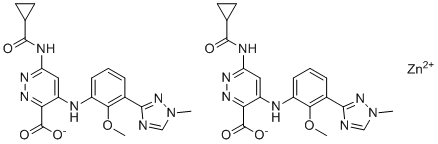 |
| Molecular Formula | C38H36N14O8Zn |
| Molecular Weight | 882.16 |
| CAS Registry Number | 2245111-19-5 |
| SMILES | CN1C=NC(=N1)C2=C(C(=CC=C2)NC3=CC(=NN=C3C(=O)[O-])NC(=O)C4CC4)OC.CN1C=NC(=N1)C2=C(C(=CC=C2)NC3=CC(=NN=C3C(=O)[O-])NC(=O)C4CC4)OC.[Zn+2] |
 Discovory and Applicatios
|
Zinc(II) 6-(cyclopropanecarboxamido)-4-((2-methoxy-3-(1-methyl-1H-1,2,4-triazol-3-yl)phenyl)amino)pyridazine-3-carboxylate is a complex chemical compound that has attracted interest due to its potential biological activity and applications in medicinal chemistry. The structure of the compound incorporates a zinc ion coordinated to a pyridazine ring, with various functional groups attached to its core structure, such as a cyclopropanecarboxamide and a triazole-containing phenylamine. This intricate structure suggests that the compound may interact with biological targets in a way that could be useful in the development of new therapeutic agents. The discovery of this compound is part of ongoing research into the design of metal-containing complexes that exhibit biological activity, particularly those that can interact with enzymes or other biomolecules in a highly selective manner. The inclusion of a zinc(II) center is particularly noteworthy, as zinc ions play crucial roles in various biological processes, including enzyme catalysis, protein function, and cellular signaling. The ability of zinc(II) to coordinate with ligands such as the pyridazine and triazole groups may enhance the compound's stability and selectivity, making it a candidate for further investigation in drug development. The synthesis of Zinc(II) 6-(cyclopropanecarboxamido)-4-((2-methoxy-3-(1-methyl-1H-1,2,4-triazol-3-yl)phenyl)amino)pyridazine-3-carboxylate typically involves a multi-step process, which includes the formation of the zinc complex and the attachment of the various functional groups to the pyridazine core. The presence of the cyclopropane and triazole units adds complexity to the synthesis, requiring precise control of reaction conditions to ensure the correct formation of the desired product. The final compound's stability and solubility are key considerations in its potential as a pharmaceutical agent. In terms of application, this compound is of particular interest as a potential therapeutic agent for conditions where zinc-dependent enzymes or pathways play a critical role. The combination of the zinc center with bioactive functional groups suggests that the compound may be able to modulate enzymatic activity or influence signaling pathways involved in disease processes. For example, it could have applications in cancer treatment, where zinc ions are involved in the regulation of cellular growth and apoptosis. Additionally, the triazole and phenylamine portions of the molecule may provide further specificity for interactions with biological targets, such as receptors or enzymes implicated in various diseases. Ongoing research is focused on evaluating the biological activity of Zinc(II) 6-(cyclopropanecarboxamido)-4-((2-methoxy-3-(1-methyl-1H-1,2,4-triazol-3-yl)phenyl)amino)pyridazine-3-carboxylate in vitro and in vivo to determine its efficacy and potential as a therapeutic agent. The compound’s ability to influence zinc-dependent processes and its complex structure make it a promising candidate for further development in the field of drug discovery. |
| Market Analysis Reports |
| List of Reports Available for Zinc(II) 6-(cyclopropanecarboxamido)-4-((2-methoxy-3-(1-methyl-1H-1,2,4-triazol-3-yl)phenyl)amino)pyridazine-3-carboxylate |