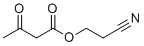
2-Cyanoethyl 3-oxobutanoate is an organic compound containing both ester and nitrile functional groups, combining the reactivity of a β-keto ester with the electrophilic characteristics of a cyanoethyl substituent. Its molecular formula is C8H11NO3, with a molecular weight of approximately 169.18 g/mol. Structurally, it features a 3-oxobutanoate fragment esterified with a 2-cyanoethyl alcohol derivative, resulting in a molecule that possesses an acidic α-hydrogen between two electron-withdrawing groups and a conjugated carbonyl system capable of participating in diverse organic transformations. The presence of both the ester and nitrile functions makes this compound a versatile building block in synthetic chemistry.
Synthesis of 2-cyanoethyl 3-oxobutanoate commonly begins from ethyl cyanoacetate or 3-oxobutanoic acid derivatives. One method involves esterification of 3-oxobutanoic acid with 2-cyanoethanol under acidic catalysis, producing the ester linkage through condensation. Another approach utilizes transesterification reactions between 3-oxobutanoate esters and 2-cyanoethanol, facilitated by acid or base catalysts. Alternatively, formation can occur through acylation of cyanomethyl-derived alcohols with β-keto acid chlorides in the presence of mild bases. Reaction parameters such as temperature, solvent, and catalyst concentration are selected to prevent decomposition of the β-keto structure and to avoid side reactions including self-condensation or polymerization.
Chemically, the compound displays classic β-keto ester reactivity. The methylene group positioned between the two carbonyl systems is activated toward deprotonation, forming stabilized enolate species. These intermediates serve as nucleophiles in alkylation, acylation, and Michael addition reactions, enabling formation of carbon–carbon bonds and incorporation into more complex molecular frameworks. The ester group can undergo hydrolysis under acidic or basic conditions, yielding β-keto acids or their salts. The nitrile group contributes additional synthetic utility, capable of hydrolysis, reduction, or transformation into amide, carboxylic acid, or heterocyclic derivatives. Through controlled manipulation of these functionalities, chemists obtain a broad range of products from a single starting material.
Physically, 2-cyanoethyl 3-oxobutanoate is typically encountered as a liquid or low-melting solid. It dissolves readily in polar organic solvents including methanol, ethanol, acetone, and ethyl acetate. Its stability is dependent on storage conditions; exposure to strong bases, high temperatures, or prolonged moisture may lead to hydrolysis or degradation of the β-keto ester. In contrast, under neutral and dry conditions it remains chemically stable for extended periods. Controlled storage minimizes potential decomposition pathways and preserves purity for synthetic use.
In laboratory and industrial contexts, 2-cyanoethyl 3-oxobutanoate is applied as a precursor in the synthesis of heterocycles, functionalized β-keto acids, and substituted acetoacetate derivatives. It is particularly valuable in the preparation of pyridines, pyrazoles, and other nitrogen-containing rings, where the nitrile moiety is transformed intramolecularly during cyclization processes. The molecule also functions as a synthon for specialized intermediates in pharmaceutical research, where its modular structure allows systematic modification of lipophilicity, polarity, and steric profile. The ability to functionalize either the enolate position, the ester group, or the nitrile group provides considerable flexibility in multistep synthetic sequences.
The compound supports the construction of diverse chemical architectures by providing three chemically distinct reactive positions: the acidic α-site for carbon–carbon bond formation, the ester for condensation or hydrolysis, and the nitrile for additional derivatization. For this reason, 2-cyanoethyl 3-oxobutanoate is incorporated into strategies aimed at optimizing molecular frameworks, generating libraries of candidate molecules, and exploring structure–activity relationships in applied research.
Overall, 2-cyanoethyl 3-oxobutanoate exemplifies a multifunctional β-keto ester with substantial synthetic value. Its balanced reactivity, predictable behavior under standard laboratory conditions, and adaptability to numerous reaction types make it a useful intermediate for construction of complex organic molecules across academic and industrial disciplines.
|




 GHS07 Warning Details
 chemBlink Chemical Story