
Online Database of Chemicals from Around the World
| Shanghai Send Pharmaceutical Technology Co., Ltd. | China | |||
|---|---|---|---|---|
 | www.shsendpharma.com | |||
 | +86 (0)21) 5808-8081 | |||
 | sale@shsendpharm.com | |||
 | QQ Chat | |||
| Chemical manufacturer since 2012 | ||||
| chemBlink Standard supplier since 2024 | ||||
| Classification | Flavors and spices >> Synthetic spice >> Hydrocarbon spice >> Aliphatic and aromatic hydrocarbons |
|---|---|
| Name | Ethyl 2-amino-2-iminoacetate hydrochloride |
| Molecular Structure | 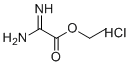 |
| Molecular Formula | C4H9ClN2O2 |
| Molecular Weight | 152.58 |
| CAS Registry Number | 76029-62-4 |
| EC Number | 888-930-0 |
| SMILES | CCOC(=O)C(=N)N.Cl |
| Hazard Symbols |  GHS07 Warning Details GHS07 Warning Details | ||||||||||||||||
|---|---|---|---|---|---|---|---|---|---|---|---|---|---|---|---|---|---|
| Risk Statements | H315-H319-H335 Details | ||||||||||||||||
| Safety Statements | P261-P264-P264+P265-P271-P280-P302+P352-P304+P340-P305+P351+P338-P319-P321-P332+P317-P337+P317-P362+P364-P403+P233-P405-P501 Details | ||||||||||||||||
| Hazard Classification | |||||||||||||||||
| |||||||||||||||||
| SDS | Available | ||||||||||||||||
 chemBlink Chemical Story
|
Ethyl 2-amino-2-iminoacetate hydrochloride is a versatile organic compound with a structure that includes an ethyl ester, an amino group, and an imino group, forming part of a unique functional framework. This compound is often used as a reagent and building block in synthetic organic chemistry, particularly in the preparation of guanidine derivatives and other nitrogen-rich compounds. The hydrochloride form of the compound makes it more stable and easier to handle, as it is often used in reaction conditions where solubility and stability are critical. The discovery of ethyl 2-amino-2-iminoacetate hydrochloride is linked to the broader exploration of guanidine chemistry in the early 20th century. Chemists sought to develop compounds that could be easily transformed into guanidines, which have significant applications in pharmaceuticals, particularly in drug design targeting enzymes and receptors due to their basic nature and ability to form hydrogen bonds. Ethyl 2-amino-2-iminoacetate hydrochloride was recognized as a key intermediate that could be functionalized in various ways, leading to a range of biologically active molecules. One of the main applications of ethyl 2-amino-2-iminoacetate hydrochloride is its use in the synthesis of guanidine derivatives. Guanidines are critical in biological systems and are found in various biologically active molecules, including antiviral and anticancer agents. The amino and imino groups present in ethyl 2-amino-2-iminoacetate hydrochloride provide a versatile platform for creating these derivatives, as they allow for further functionalization to tailor the chemical properties of the resulting molecules. Another application of ethyl 2-amino-2-iminoacetate hydrochloride is in the field of peptide chemistry. Its nitrogen-rich structure makes it a useful reagent for modifying amino acid residues or for introducing guanidine functionalities into peptides, which can enhance binding affinities to biological targets. This has implications in drug design, where small changes in molecular structure can lead to significant improvements in efficacy and selectivity. In addition, ethyl 2-amino-2-iminoacetate hydrochloride is used in the synthesis of heterocyclic compounds, which are core structures in many pharmaceuticals. The reactivity of the compound allows for the construction of five- or six-membered nitrogen-containing rings, which are commonly found in biologically active molecules. These heterocycles can exhibit a wide range of biological activities, including antibacterial, antifungal, and antiviral properties. Ethyl 2-amino-2-iminoacetate hydrochloride has also been explored in the development of agrochemicals, where nitrogen-containing compounds play a critical role in the synthesis of herbicides and pesticides. The ability to introduce guanidine groups or related functionalities provides chemists with the tools to create compounds that can disrupt biological pathways in pests or weeds without affecting crops. Overall, ethyl 2-amino-2-iminoacetate hydrochloride is a valuable chemical intermediate with a range of applications in pharmaceutical development, peptide chemistry, and agrochemical synthesis. Its versatility in forming guanidine derivatives and nitrogen-containing heterocycles makes it an indispensable tool for chemists working in the design of biologically active molecules. |
| Market Analysis Reports |