
Online Database of Chemicals from Around the World
| Simagchem Corporation | China | |||
|---|---|---|---|---|
 | www.simagchem.com | |||
 | +86 13806087780 | |||
 | +86 (592) 268-0237 | |||
 | sale@simagchem.com | |||
| Chemical manufacturer since 2002 | ||||
| chemBlink Standard supplier since 2008 | ||||
| Zhanhua Darong Chemical Technology Co., Ltd. | China | |||
|---|---|---|---|---|
| www.darongchem.com | |||
| +86 (532) 6777-3200 +86 15689126900 | |||
| +86 (532) 6777-3200 | |||
| sales@darongchem.com | |||
 | QQ Chat | |||
| Chemical manufacturer since 2011 | ||||
| chemBlink Standard supplier since 2009 | ||||
| BOC Sciences | USA | |||
|---|---|---|---|---|
| www.bocsci.com | |||
| +1 (631) 485-4226 | |||
| +1 (631) 614-7828 | |||
| info@bocsci.com | |||
| Chemical manufacturer | ||||
| chemBlink Standard supplier since 2010 | ||||
| Synchemer Co., Limited | China | |||
|---|---|---|---|---|
| www.synchemer.com | |||
| +86 (20) 3668-5350 +86 13556109416 | |||
| +86 (20) 3668-6430 | |||
| info@synchemer.com | |||
| Chemical manufacturer since 2013 | ||||
| chemBlink Standard supplier since 2013 | ||||
| Eastar Chemical Corporation | USA | |||
|---|---|---|---|---|
| www.eastarchem.com | |||
| +1 800-898-2436 | |||
| +1 (877) 898-2436 | |||
| info@eastarchem.com | |||
| Chemical manufacturer since 1989 | ||||
| chemBlink Standard supplier since 2014 | ||||
| Hangzhou Leap Chem Co., Ltd. | China | |||
|---|---|---|---|---|
| www.leapchem.com | |||
| +86 (571) 8771-1850 | |||
| market19@leapchem.com | |||
| QQ Chat | |||
| Chemical manufacturer since 2006 | ||||
| chemBlink Standard supplier since 2015 | ||||
| Shanghai Deborn Co., Ltd. | China | |||
|---|---|---|---|---|
| www.shdeborn.com | |||
| +86 (21) 6896-2123 +86 18017879299 | |||
| +86 (21) 6896-3669 | |||
| sales@shdeborn.com victorcheng@263.net | |||
| QQ Chat | |||
 | Skype Chat | |||
| Chemical distributor since 2013 | ||||
| chemBlink Standard supplier since 2016 | ||||
| Eustar Functional Material Technology, Inc. | China | |||
|---|---|---|---|---|
| www.eustar.com.cn | |||
| +86 (0512) 5510-5882 | |||
| purchaser@eustar.com.cn | |||
| Chemical manufacturer since 2014 | ||||
| chemBlink Standard supplier since 2024 | ||||
| Changzhou Suntton Co., Ltd. | USA | |||
|---|---|---|---|---|
| www.suntton.com | |||
| +1 (914) 965-2077 +86 (519) 8513-6089 | |||
| +1 (914) 375-2093 / +86 (519) 8513-6133 | |||
| luke.verdet@suntton.com lily.chen@suntton.com | |||
| Chemical manufacturer | ||||
| Classification | Chemical reagent >> Organic reagent >> Phosphonate / phosphonate |
|---|---|
| Name | Sodium 2,2'-methylene-bis-(4,6-di-tert-butylphenyl)phosphate |
| Synonyms | 2,4,8,10-Tetrakis(1,1-dimethylethyl)-6-hydroxy-12H-dibenzo[d,g][1,3,2]dioxaphosphocin 6-oxide sodium salt |
| Molecular Structure | 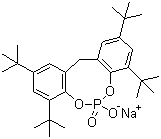 |
| Molecular Formula | C29H42NaO4P |
| Molecular Weight | 508.61 |
| CAS Registry Number | 85209-91-2 |
| EC Number | 286-344-4 |
| SMILES | CC(C)(C)C1=CC2=C(C(=C1)C(C)(C)C)OP(=O)(OC3=C(C2)C=C(C=C3C(C)(C)C)C(C)(C)C)[O-].[Na+] |
| Melting point | >300 °C (Expl.) |
|---|---|
| Hazard Symbols |   GHS07;GHS09 Warning Details GHS07;GHS09 Warning Details | ||||||||||||||||||||
|---|---|---|---|---|---|---|---|---|---|---|---|---|---|---|---|---|---|---|---|---|---|
| Risk Statements | H332-H411-H412 Details | ||||||||||||||||||||
| Safety Statements | P261-P271-P273-P304+P340-P317-P391-P501 Details | ||||||||||||||||||||
| Hazard Classification | |||||||||||||||||||||
| |||||||||||||||||||||
| Transport Information | UN 3077 | ||||||||||||||||||||
| SDS | Available | ||||||||||||||||||||
 Discovery and Applications
|
Sodium 2,2'-methylene-bis-(4,6-di-tert-butylphenyl)phosphate is a prominent organophosphate compound known for its antioxidant properties and its application in polymer stabilization. The compound, characterized by its bulky tert-butyl-substituted phenyl groups and a sodium phosphate moiety, plays a critical role in preserving the integrity of materials subjected to oxidative stress, particularly polymers and plastics. Its discovery and development reflect the ongoing advancements in additive chemistry aimed at enhancing material performance. The synthesis of sodium 2,2'-methylene-bis-(4,6-di-tert-butylphenyl)phosphate can be traced to research in the mid-20th century, which focused on organophosphates as stabilizers. Researchers identified the compound's ability to scavenge free radicals effectively, a property derived from its sterically hindered phenolic groups. This functionality inhibits oxidation processes that degrade polymers, making the compound a key ingredient in stabilizer formulations. In industrial applications, sodium 2,2'-methylene-bis-(4,6-di-tert-butylphenyl)phosphate is widely used as an antioxidant additive in the production of plastics, rubbers, and elastomers. Its role is particularly significant in polyolefins such as polyethylene and polypropylene, where it prevents thermal and oxidative degradation during manufacturing and prolonged use. The compound's high thermal stability and low volatility make it suitable for high-temperature processing, ensuring consistent protection throughout the material's lifecycle. The compound also finds applications in coatings, adhesives, and lubricants, where oxidative stability is crucial. In these formulations, sodium 2,2'-methylene-bis-(4,6-di-tert-butylphenyl)phosphate enhances product durability and maintains performance under harsh environmental conditions, such as exposure to heat and UV radiation. Additionally, its compatibility with other stabilizers, such as hindered amine light stabilizers (HALS), allows for synergistic effects that further extend the longevity of materials. Recent research has explored the environmental and health aspects of using sodium 2,2'-methylene-bis-(4,6-di-tert-butylphenyl)phosphate. Studies indicate that the compound is effective in very low concentrations, minimizing its environmental footprint. Efforts are also underway to develop biodegradable analogs and alternative synthetic routes that align with green chemistry principles. The versatility and effectiveness of sodium 2,2'-methylene-bis-(4,6-di-tert-butylphenyl)phosphate ensure its continued use across multiple industries. As demand for durable and sustainable materials grows, this compound remains a cornerstone of modern material science, contributing to innovation in polymer technology and beyond. References 2024. Influence of nucleating agent on the mechanical and thermal properties of neat isotactic polypropylene/reprocessed polypropylene blends. Iranian Polymer Journal, 33(10). DOI: 10.1007/s13726-024-01369-8 2020. Non-isothermal crystallization behavior of isotactic polypropylene/copper nanocomposites. Journal of Thermal Analysis and Calorimetry, 141(5). DOI: 10.1007/s10973-020-09512-2 2015. Preparation and foaming mechanism of foamable polypropylene based on self-assembled nanofibrils from sorbitol nucleating agents. Journal of Materials Science, 50(22). DOI: 10.1007/s10853-015-9402-5 |
| Market Analysis Reports |