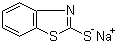
Sodium mercaptobenzothiazole is an important chemical compound that has found wide applications in various industrial fields, particularly in the rubber and plastics industries. This compound is the sodium salt of mercaptobenzothiazole (MBT), which is a derivative of benzothiazole, a bicyclic organic compound. The discovery of mercaptobenzothiazole can be traced back to the early 20th century, during a period of significant growth in the development of chemical compounds for industrial applications.
The synthesis of mercaptobenzothiazole involves the reaction of benzothiazole with a thiol group, resulting in the formation of a thiazole ring that contains a sulfur atom. Sodium mercaptobenzothiazole is typically produced through the neutralization of mercaptobenzothiazole with sodium hydroxide. This compound is characterized by its ability to function as a rubber accelerator, which enhances the curing process of rubber products. The use of accelerators like sodium mercaptobenzothiazole allows manufacturers to produce rubber materials with improved mechanical properties and increased resistance to aging.
In the rubber industry, sodium mercaptobenzothiazole is predominantly used as a vulcanization accelerator. During the vulcanization process, rubber is treated with sulfur to create cross-links between polymer chains, which significantly enhances its strength and elasticity. Sodium mercaptobenzothiazole serves to accelerate this reaction, allowing for shorter processing times and improved efficiency in rubber production. Its effectiveness in this application has made it a preferred choice among manufacturers, particularly for producing tires, seals, and gaskets.
Beyond its role in rubber production, sodium mercaptobenzothiazole is also utilized in the formulation of various plastics and coatings. Its presence enhances the thermal stability and weather resistance of these materials, making them suitable for outdoor applications. This capability is particularly valuable in sectors such as construction and automotive manufacturing, where durability and resistance to environmental factors are crucial.
Moreover, sodium mercaptobenzothiazole has found applications in the field of agriculture as a fungicide and pesticide. Its antimicrobial properties enable it to inhibit the growth of various fungi and bacteria, making it effective in protecting crops from diseases. This dual functionality as a chemical in both industrial and agricultural contexts demonstrates the versatility of sodium mercaptobenzothiazole.
However, the use of sodium mercaptobenzothiazole is not without concerns. There are ongoing discussions regarding its safety and potential environmental impact. Studies have indicated that mercaptobenzothiazole and its derivatives may pose risks to aquatic life and can be toxic in certain concentrations. Consequently, regulatory agencies are closely monitoring its use, prompting manufacturers to explore safer alternatives and improved formulations that minimize health and environmental risks.
In summary, sodium mercaptobenzothiazole is a valuable chemical substance with significant applications in the rubber, plastics, and agricultural industries. Its discovery marked a notable advancement in the development of materials with enhanced properties, particularly in terms of durability and resistance to environmental degradation. As the industry continues to evolve, addressing safety and environmental concerns will be essential to ensuring the sustainable use of this compound in various applications.
References
2019. High strength Cu foil without self-annealing prepared by 2M5S-PEG-SPS. *Korean Journal of Chemical Engineering*, 36(6).
DOI: 10.1007/s11814-019-0279-x
2016. 2-Mercaptobenzimidazole, 2-Mercaptobenzothiazole, and Thioglycolic Acid as Additives for Electrolytic Ni Plating. *Iranian Journal of Science and Technology, Transactions A: Science*, 40(3).
DOI: 10.1007/s40995-016-0142-4
1983. The Merck Index - Encyclopedia of Chemicals, Drugs and Biologicals. Rahway, NJ: Merck and Co., Inc., p. 923.
|






 GHS05;GHS07;GHS09 Danger Details
 chemBlink Chemical Story